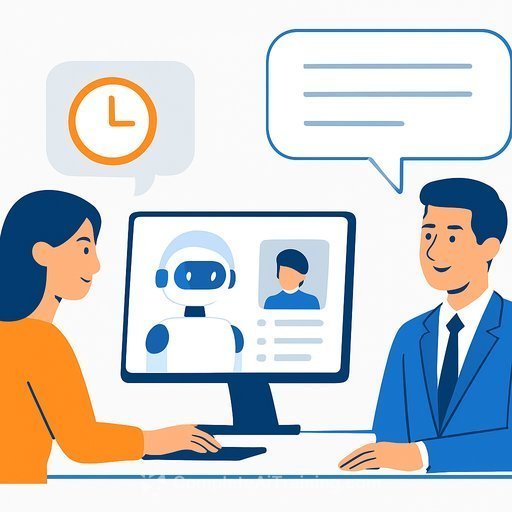
AI hiring is here. Everyone's frustrated. HR can change that.
AI-led interviews and auto-written cover letters have flooded the hiring pipeline. More than half of organizations used AI to recruit in 2025, and a big share of candidates leaned on chatbots to apply - often at scale.
Here's the twist: research from Dartmouth and Princeton found that after ChatGPT arrived, cover letters got longer and cleaner, but less useful. Employers stopped trusting them, hiring rates fell, and starting wages dipped. More volume. Less signal.
Interviews are automated. The bias risk didn't disappear.
Over half (54%) of US job seekers say they've had an AI-led interview. The format changed, but human judgment - and human bias patterns - still sneak in through the data and the design.
"Algorithms can copy and even magnify human biases," said researcher Djurre Holtrop. Greenhouse CEO Daniel Chait warned about a "doom loop" where candidates use AI to spray applications and companies add more automation to cope. Both sides get miserable. Quality suffers.
Legal pressure is building
States like California, Colorado, and Illinois are writing rules for AI in hiring. A recent federal executive order adds uncertainty, but doesn't wipe out state laws. And the core rules still apply: anti-discrimination laws cover AI the same way they cover people.
Lawsuits have started. In one ACLU-backed case, a deaf applicant says an automated interview from HireVue failed accessibility standards. HireVue denied the claim and said its system is built to reduce bias using validated behavioral science.
What HR can do this quarter
- Cut low-signal steps. Stop scoring cover letters. Ask 3-5 role-specific, short-answer questions instead.
- Add work samples or job simulations. Use structured tasks and clear rubrics that reward job-relevant skill, not writing polish.
- Create a simple friction layer to reduce spam: knockout questions, required portfolio link, or a brief scenario response.
- Standardize interviews. Structured questions, anchored ratings, interviewer calibration, and double-review on close calls.
- Disclose where AI is used. Offer a fast path to a human reviewer on request.
- Provide accommodations by default: alternate formats, extended time, accessible tech, and a listed contact person.
- Vendor due diligence: ask for validation studies, adverse-impact testing, accessibility conformance, data-use limits, and human-in-the-loop controls.
- Monitor outcomes weekly: pass rates by stage, adverse-impact ratios, source quality, and interview-to-offer conversion.
Policy checklist you can ship
- AI use statement: where, why, and how decisions are supported (not made) by AI.
- Right to human review: candidates can request it at any stage.
- Accommodation protocol: simple request flow, SLA, and approved alternatives.
- Data policy: retention limits, model training consent, and deletion process.
- Vendor requirements: documentation, audit rights, bias testing cadence, and change notifications.
- Explainability & appeals: plain-language feedback and a channel to contest outcomes.
- Annual review: refresh rubrics, revalidate tools, retrain interviewers.
Teams building or updating these policies can follow the AI Learning Path for Regulatory Affairs Specialists for checklists and human-in-the-loop guidance.
Measure what actually improves hiring
- Qualified-to-total applicant ratio
- Stage pass rates by demographic group (watch adverse-impact ratios)
- Interview-to-offer and offer-to-accept rates
- Time-to-fill and quality-of-hire (90-day success proxy)
- Candidate NPS and complaint rate
- Source performance (which channels produce finalists)
For enterprise governance, auditing, and oversight practices that support these measures, consider the AI Learning Path for CIOs.
Better candidate experience, fewer drop-offs
- Publish the process: stages, timelines, and who's involved.
- Offer practice questions for AI or video interviews; allow retakes once.
- Give concise, specific feedback when declining at later stages.
- Keep humans present: a live touchpoint for finalists, every time.
Break the loop
The signal is buried under automation on both sides. Your advantage is simple: design for proof of skill, standardize how you judge it, and keep a human accountable for the final call.
As one candidate put it after an AI recruiter call felt "cold," "Some great people are going to be left behind." HR can make sure they aren't.
Useful references for your playbook:
- EEOC guidance on AI and the ADA in hiring: read the guidance
- NIST AI Risk Management Framework (governance and controls): framework overview
- Research
If your team needs structured upskilling on evaluating and applying AI responsibly in HR, explore role-based options here: AI courses by job
Your membership also unlocks: