Dutch AI Adoption Doubles - But Most Teams Still Sit on the Sidelines
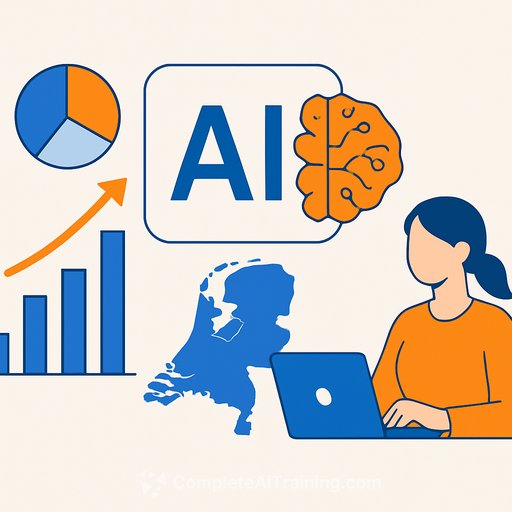
One in six companies in the Netherlands used AI in 2025, double the share in 2023, according to CBS. Adoption skews big: 66 percent among firms with 250+ employees, and 45 percent in the 50-250 range. Most small companies still haven't moved. Three-quarters of firms don't use AI at all.
Where AI Is Actually Used
AI shows up most in marketing and sales (35 percent), administration and management (32 percent), and research or innovation (25 percent). Logistics is barely touched at 4 percent. That tells you where the immediate payoffs are: revenue, reporting, and product development.
- Trade: nearly half use AI, mostly for marketing or sales.
- Information & communication, and business services: around 40 percent use AI for marketing or sales.
- Financial services: more than half use AI for administration.
- Hospitality, transport, storage, construction: lowest use, at 6-7 percent.
The Tech Behind the Uptick
Text mining leads at 12 percent (up from 4 percent in 2023). Natural language generation sits at 8 percent. Speech recognition has tripled to 6 percent. Machine learning and robotic process automation are climbing too.
In practical terms: text mining pulls insights from customer chats, emails, and reviews; NLG drafts product pages, reports, and emails; speech tech summarizes calls; RPA and ML handle repetitive admin and forecasting. None of this is theoretical. It's basic blocks teams can ship in weeks.
Why Most Companies Still Hold Back
Among firms that considered AI but didn't adopt it, 73 percent cite lack of experience, 49 percent worry about privacy, and 42 percent point to legal uncertainty. Fair concerns. Also solvable.
- Start small: one clear use case, one owner, a 4-8 week pilot, and defined ROI.
- Set guardrails: data retention rules, human-in-the-loop review, vendor risk checks, and audit logs.
- Upskill fast: give your team playbooks and short courses; measure usage and outcomes, not hours spent learning.
- Document everything: prompts, workflows, approvals, and outputs. Treat AI like software, not magic.
How the Netherlands Stacks Up
Eurostat reports that 20 percent of EU companies with at least 10 employees used AI in 2025, up from 13.5 percent in 2024. The Netherlands sits under that at roughly 16 percent. As one industry voice put it: "We are falling far behind. In the U.S., companies are reinventing themselves, convinced that 60 to 70 percent of office work can be done by AI. That kind of drive is clearly not present here."
If you lead marketing, sales, or operations, that gap is an opportunity. Lower cost per lead, faster cycles, and cleaner admin are on the table for whoever moves first.
Your 90-Day AI Plan (Marketing, Sales, Ops)
- Marketing: Ship an AI-assisted content system for product pages, emails, and ads. Use text mining to turn support tickets and reviews into messaging. A/B test headlines and CTAs generated with clear brand rules.
- Sales: Auto-summarize calls and push notes to CRM. Draft first-pass outreach and follow-ups based on ICP and deal stage. Build a lead scoring model from historical wins and activity signals.
- Admin: Use RPA + OCR for invoices, expenses, and compliance checks. Spin up AI help for policy Q&A to cut internal ticket volume.
- Research & Product: Analyze competitor websites and docs with text mining. Generate concept briefs and test them with small audiences before you spend design or dev time.
- Data & Governance: Define which data can be used, who approves prompts and workflows, and how outputs are reviewed. Keep humans responsible for final decisions.
Metrics That Matter
- Marketing: cost per qualified lead, time to ship a campaign, content throughput per person.
- Sales: time-to-first-response, meeting notes coverage, forecast accuracy, win rate.
- Admin: cycle time per invoice or ticket, error rates, audit readiness.
- Team: weekly active AI users, number of documented workflows, percentage of outputs reviewed.
Common Traps to Avoid
- Buying tools before defining a process. Nail the workflow first, then pick vendors.
- Letting legal or IT be the "no" by default. Bring them in early, agree on constraints, and move.
- Trying to automate everything. Start with repetitive, high-volume tasks that touch revenue or cost.
- No ownership. Assign a business owner, not just an "AI person." Accountability drives outcomes.
Useful Sources and Next Steps
For a macro view of adoption, see official statistics from Statistics Netherlands (CBS) and Eurostat. For hands-on enablement, give your team structured training and ready-to-use playbooks.
- AI courses by job role for marketing, sales, and operations teams
- Certification for marketing specialists to standardize skills and workflows
The signal is clear: adoption is climbing, value is concentrated in a few high-impact areas, and the gap between early movers and everyone else is widening. Pick one use case, set the rules, and prove ROI in a month. Then scale what works.
Your membership also unlocks: