
AI news ·
AI use grows among Utah businesses but job seekers bear the cost of automated hiring
60% of large companies now use AI to screen, interview, and evaluate job candidates-often without telling applicants. Only 1 in 4 applicants trust AI to assess them fairly.
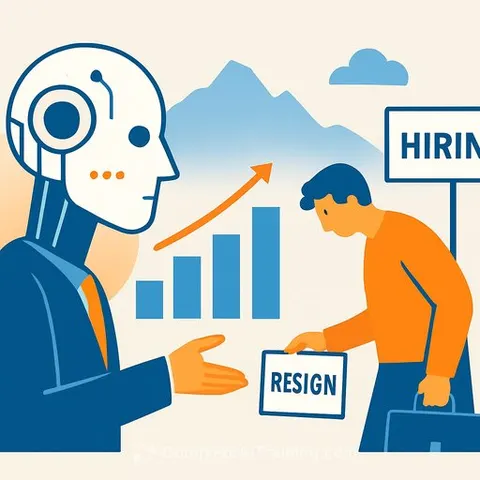
AI Hiring Tools Are Reshaping Recruitment-But Nobody's Happy About It
Thirty-nine percent of HR departments now use AI in their hiring process. Among large companies, that number jumps to 60 percent. The technology filters resumes, schedules interviews, conducts them, and summarizes results-sometimes without candidates knowing they're being evaluated by a machine.
For job seekers, the experience has become opaque and frustrating. A survey from an HR software company found that 63 percent of applicants had experienced an AI interview, and 70 percent of the time they weren't told. Most applicants heard nothing back after these automated evaluations. Only one-quarter said they trusted AI to fairly assess their qualifications.
HR professionals, meanwhile, say they see AI as fair as human reviewers. That gap in perception matters. It shapes how candidates experience your organization and whether they'll apply again.
The Volume Problem
The volume of applications has become unmanageable without automation. When a tech company in Utah posted a single job opening, it received 1,200 applications-many written by AI. Processing that manually isn't realistic.
But automation creates a feedback loop. Applicants use AI to write resumes and cover letters. Companies use AI to filter them. Neither side gets real human attention. Neither side benefits except the AI vendors.
What Regulation Exists
New York City passed a law in 2021 requiring employers using "automated employment decision tools" to audit them for fairness and disclose how they work. Companies including Morgan Stanley, Wells Fargo, Cigna, and ADP-all with Utah operations-have registered their systems.
Regulation remains sparse elsewhere. Most states and the federal government haven't imposed similar requirements.
The Bigger Picture on Jobs
Utah ranks eighth nationally in business AI adoption. As of April, 26.5 percent of Utah businesses expected to use AI within six months, and 22.6 percent already had. That's still less than one-third of the state's businesses.
Job openings have declined 20 percent overall in Utah over the past few years. But software development-an AI-related field-saw only an 8.2 percent drop. Fields like business operations and finance fell 13 percent. The pattern suggests some sectors are weathering the shift better than others.
Research from Stanford found no substantial difference in overall employment or earnings in AI-exposed industries. But within those industries, the split is stark: college-educated workers fared better. Lower-educated workers saw employment declines. Entry-level positions bore the heaviest burden, according to a study by Anthropic, the AI company whose CEO predicted AI could replace half of entry-level white-collar jobs within five years.
For HR Leaders
The hiring process is becoming less human at the exact moment when candidates need human attention most. Learn more about AI for Human Resources and how to implement these tools responsibly, or explore AI strategy for CHROs to guide your organization's approach.
The question isn't whether to use AI in hiring. Most competitive employers already do. The question is whether you'll use it in ways that keep human judgment in the process-and whether you'll be transparent about it.