
AI news ·
AI use in invention disclosures creates inventorship and public disclosure risks, IP attorneys warn
Patent attorneys must warn clients that using AI tools to draft invention disclosures risks inventorship challenges and unintended public disclosure. Consumer-tier AI accounts can void patentability and waive attorney-client privilege.
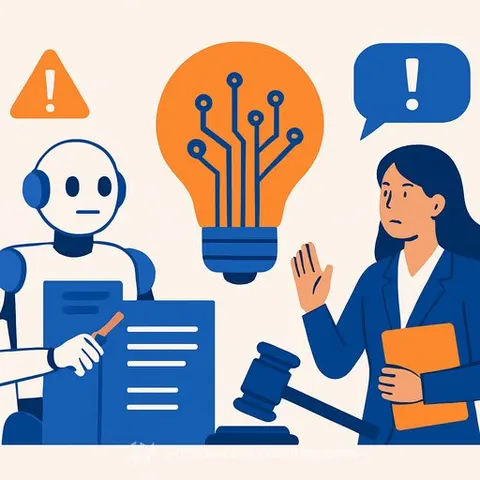
Patent Attorneys Must Warn Clients About AI Disclosure Risks
Artificial intelligence is reshaping patent prosecution, but invention disclosures created with AI tools are exposing clients to serious legal risks. IP attorneys need to educate clients early about two critical pitfalls: inventorship challenges and unintended public disclosure.
The problem starts with a misconception. AI tools make drafting faster and produce outputs that look polished and substantial. Clients often assume longer, denser disclosures are better. They're not.
The Inventorship Question
The U.S. Patent and Trademark Office currently maintains that AI cannot be listed as a joint inventor. The PTO presumes named human inventors are correct and has declined to establish stricter standards for AI-assisted inventions.
But future uncertainty creates real risk. If the PTO responds to a surge in AI-assisted filings with new rules, inventorship could become a highly factual inquiry. Courts may demand historical records showing how inventors used AI. Clients who relied heavily on AI to generate ideas rather than refine text could fail to meet the threshold for human inventorship.
The Public Disclosure Problem
The more immediate danger is inadvertent public disclosure. Feeding sensitive invention details into an AI tool can constitute disclosure to a third party, destroying patentability and waiving attorney-client privilege.
Federal courts have already ruled on this. In United States v. Heppner and Trinidad v. OpenAI, Inc., courts found that information sent to generative AI platforms constituted public disclosure. Both cases resulted in waiver of privilege and loss of trade secret protection. The deciding factor: the parties used consumer-tier accounts with terms of service allowing platforms broad rights to user inputs.
What Attorneys Should Tell Clients
Push for their own words. Short, manually drafted disclosures focusing on key details are more useful than lengthy AI outputs. An inventor's own words let you recognize true inventive features and think critically about the invention in ways AI cannot.
Audit their AI platform. If a client uses AI, ask which tier of service. Warn against consumer-tier accounts. Advise them to use only enterprise accounts or platforms with rigorous privacy protections and terms that don't claim rights to user inputs.
Shift AI's role. Instead of asking AI to expand a small idea into massive text, counsel clients to use AI to clarify specific concepts or format existing notes. This keeps AI as a refinement tool, not a content generator.
Document human contribution. Given potential PTO rule changes, recommend clients document their independent human contributions before feeding concepts into AI for refinement. Often this is simply the prompt itself or documents provided with it.
Dense, AI-generated text obscures inventive concepts and makes evaluation harder. Your role is to guide clients back to clarity. The efficiency gains from AI are real, but the risks at the disclosure stage are substantial.