
AI news ·
AI use in video game development surges 681% on Steam as studios automate QA, assets and NPC dialogue
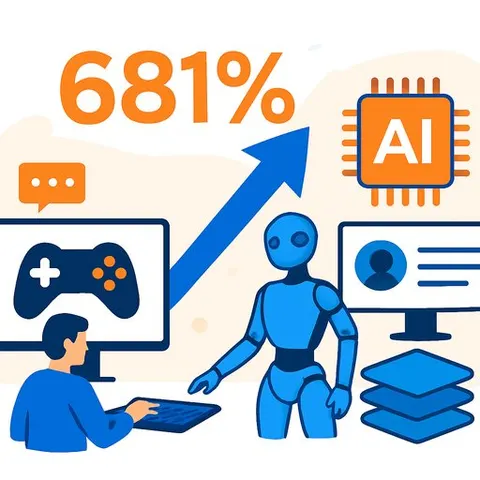
90% of game developers now use AI daily, with 7,818 Steam titles disclosing AI use in 2025 - a 681% jump year-over-year. Studios are applying it across QA, asset creation, NPC dialogue, and procedural generation.
AI is now standard in game development. Here's where it actually works.
Ninety percent of game developers are integrating AI into their daily work, according to a Google Cloud survey. On Steam, 7,818 titles disclosed AI use in 2025 alone - a 681% increase from the previous year. AI is no longer an experiment in game development. It is restructuring the production pipeline from concept through launch.
NPCs that respond to improvisation
Non-player character behaviour has moved past scripted decision trees. Ubisoft's La Forge division developed Ghostwriter, a generative AI tool that produces first-draft NPC dialogue so writers can focus on narrative rather than volume.
Large language models now give NPCs genuine memory within sessions and responses that hold up under improvised player input. AI systems monitor player performance in real time to adjust difficulty dynamically. Story engines weave branching subplots on the fly, making each playthrough distinct.
Asset creation at a fraction of the time
Concept art generation dropped from three weeks to a single hour once AI tools entered the workflow, according to research from Andreessen Horowitz.
Tencent's Hunyuan3D-PolyGen produces art-grade 3D assets with efficiency gains of over 70%, while Meta's WorldGen can generate a traversable 3D environment from a text prompt in around five minutes - ready for Unity and Unreal. Audio is following the same trajectory. ElevenLabs enables voice generation and localisation at speeds that traditional recording pipelines cannot match.
Quality assurance gets automated
QA is where AI is having the most concrete operational impact. EA has deployed reinforcement learning agents to autonomously play and stress-test games, catching edge-case bugs across a wider range of gameplay styles than human testers could cover alone.
Square Enix announced plans to automate 70% of its QA and debugging using generative AI by 2027, in partnership with the University of Tokyo. The emerging model in the industry is hybrid: AI handles the mechanical volume while human testers focus on judgment-driven issues that automation cannot resolve.
Procedural generation with context
Modern AI-assisted procedural systems condition generation on context rather than relying on rule-based approaches. Narrative engines now weave branching subplots that respond to player actions and inferred emotional cues, so each session reflects the shape of an individual playthrough rather than random variation.
Research frameworks like PANGeA are demonstrating that large language models can maintain narrative coherence in dynamically generated content, removing the need for exhaustive hand-authoring that has traditionally limited branching game stories.
Browser games become accessible
Web games are structurally simpler than console or PC titles. HTML5, fast load times, and pick-up-and-play mechanics mean AI tools are unusually effective at covering the gap for developers without deep technical or artistic backgrounds.
Generative AI handles concept art and basic asset creation in a fraction of the usual time. AI code generation helps less experienced developers get a functional prototype into a browser environment. Tools like FRVR AI let any user generate a playable browser game from a text description alone.
Platforms like Poki provide a natural home for these games: free to play for users, with revenue earned through advertising. The path from prototype to published title is more accessible than it has ever been.
The friction points
The expansion has not been frictionless. The flood of low-quality AI-generated titles that hit Steam in 2025 raised real questions about quality floors in an environment where content is cheap to produce.
Voice actor unions and writers' guilds are still negotiating the terms under which AI can generate dialogue or clone voices. The outcome will shape how studios deploy these tools in character-driven productions.
What the evidence suggests is that AI in game development pays for itself when it shortens the distance between creative intent and usable output. Studios finding genuine value are deploying it precisely where the production bottleneck sits.
AI design courses can help development teams understand where these tools fit into their workflows and how to integrate them effectively.