AI Will Reshape Skills and Hiring: What HR and Education Leaders Need to Do Now
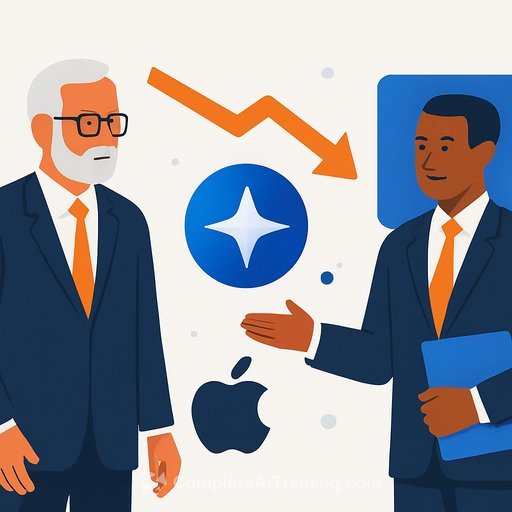
Alex Karp, CEO of Palantir, isn't sugarcoating it. He says AI will "destroy humanities jobs" and make traditional credentials harder to sell. You may disagree with the tone, but his point is clear: the market is shifting to aptitude, proof of work, and real collaboration with AI tools.
This isn't new for Palantir. The company launched a paid 'Meritocracy Fellowship' in 2025 for high school graduates to study philosophy and history, then contribute to real projects. Their stance: exceptional talent needs agency, real problems, and responsibility-not a set curriculum.
From Credentials to Capability
At Davos, Karp argued that we need "different ways of testing aptitude" because old filters miss what makes someone irreplaceable. His own path-PhD in philosophy, struggling to get a first job-shapes his view: elite schools aren't a guaranteed on-ramp anymore.
For HR and education, this means skills-based hiring isn't a buzzword-it's an operating system. The people who thrive will show hands-on ability, speed of learning, and the judgment to pair human strengths with AI output.
What the Market Data Signals
Surveys point to a reset. A 2025 view from the CHRO seat shows large moves into AI-linked roles, with most leaders preferring human-AI collaboration over replacement. Many expect minimal outright job cuts in the next two years, even as roles get reconfigured.
Another signal: top performers invest in human capabilities that tech can't replace-divergent thinking, curiosity, communication, and the ability to make sense of messy problems. That's what turns AI from a tool into real outcomes.
Why This Matters for HR
- Roles will split into task clusters: what AI does solo, what humans do solo, and what they do together.
- Interviews that probe "tell me about yourself" will give way to live simulations, portfolio reviews, and on-the-spot problem solving.
- Internal mobility and reskilling will beat external hiring sprints on cost and speed.
Practical Playbook: HR
1) Build a skills-first foundation
- Create a skills taxonomy for your top 20 roles. Map tasks to skills and mark what AI can assist, augment, or automate.
- Swap degree filters for evidence: portfolios, GitHub/Notion repos, case challenges, peer reviews, Kaggle-type results.
- Introduce short, paid trials or fellowships for non-traditional talent. Pay for output, not seat time.
2) Redesign assessment
- Use work samples with AI allowed. Judge judgment: prompts used, error checking, privacy discipline, final result quality.
- Score on learnability: how fast candidates improve between round one and round two of the same task.
- Add ethical calls: "What would you not automate here and why?"
3) Upskill the workforce you have
- Pick three high-volume workflows and build AI playbooks for each (inputs, prompts, review steps, escalation rules).
- Pair champions with teams for 4-6 weeks to coach in the workflow, not in a classroom.
- Measure time saved, error rates, and business impact-then roll out across functions.
Practical Playbook: Education
1) Teach AI with context, not just tools
- Make every course include an AI lab: prompt design, critique, fact-checking, and limits (see Design).
- Build cross-disciplinary studios: policy + data, literature + product design, ethics + engineering.
2) Change admissions and credentialing
- Prioritize portfolios and live problem-solving over GPAs alone.
- Offer micro-credentials tied to actual employer projects. Keep them stackable and update quarterly.
3) Partner with employers
- Co-create fellowships and apprenticeships modeled on Palantir's approach: high agency, real responsibility.
- Publish outcomes: placement by skill, not just by degree. Let the market see the signal.
Human + AI Collaboration: What Good Looks Like
Doug McMillon put it plainly: "AI is going to change literally every job." The organizations that win will be transparent with employees, show the work, and involve people in how tools change their day-to-day. Fear drops when people can see the plan and try it themselves.
- Run open demos: show how roles change, where AI is used, and how quality checks work.
- Publish decision logs for automation: what's in, what's out, and why.
- Reward teams for finding better workflows, not just shipping more tasks.
Assessment Ideas You Can Use Next Week
- Case-in-a-box: give raw data, context, and access to an AI tool. Ask for a brief, a draft, and a risk note.
- Replicate-and-improve: show a prior project and ask candidates to beat it with AI in 48 hours.
- Red-team test: present an AI-generated output with hidden flaws. Score how fast and how well they catch issues.
Metrics That Keep You Honest
- Time to proficiency by role (pre vs. post AI playbooks)
- Quality deltas: error rates, customer satisfaction, compliance flags
- Internal fill rate for AI-affected roles
- Share of hiring pipelines from non-traditional sources
Risk and Policy Guardrails
- Define use cases where AI is allowed, supervised, or off-limits.
- Train for privacy, IP, bias, and disclosure. Include real consequences for misses.
- Keep a human in review for high-stakes decisions. Document the check.
The Bottom Line
Karp's stance is blunt, but the signal is useful: the market is pricing skills, speed of learning, and the ability to work with AI in the open. Degrees still matter for some fields, but they're a weak proxy on their own. Build systems that find and grow aptitude-then prove it with outcomes.
Helpful Resources
Your membership also unlocks: