UK employers must support staff to get the most from AI
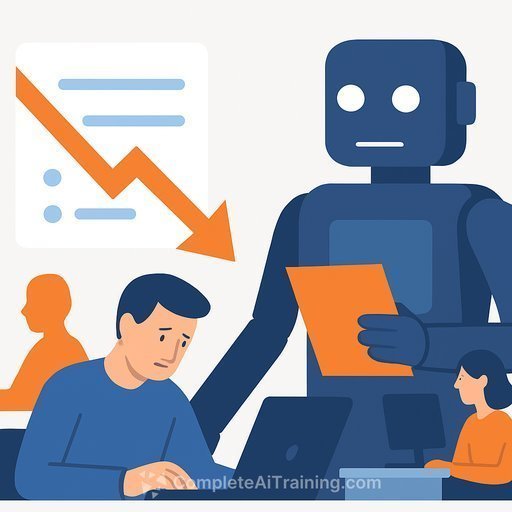
The jobs market has cooled, and many employers are using AI's rise to keep expectations low. Quit intent has fallen to 29% in 2025, even as 62% of staff report heavier workloads and just 11% say they receive adequate AI training. That dynamic keeps people in place, but it also caps performance.
According to the EY 2025 Work Reimagined Survey, employees who are well trained in AI are 59% more likely to move on. External offers are beating internal opportunities, so some firms are holding back on training to protect retention and suppress wage pressure. It's a short-term play that slows productivity and fuels disengagement.
What the data says
Quit intent jumped from 7% in 2021 to 43% in 2022, then dropped to 29% in 2025 as uncertainty grew. Meanwhile, workload went up for 62% of employees, while meaningful training flatlined at 11%.
Training matters. UK employees receiving more than 81 hours of AI training a year report an average productivity boost of 14 hours per week, far above the median of eight hours. In other words: the work is there, the lift is available, but the skills gap blocks the gains.
Buying tools isn't enough. Organisations with weak talent strategies-poor training, thin culture, and misaligned rewards-see AI productivity gains lag by over 40%. Only 37% of UK employers are on track to combine culture, learning, and rewards into a coherent talent system.
The takeaway for HR
AI delivers when talent foundations are in place. That means building skills, reducing fear, and rewarding adoption. Ignore those basics and you'll spend on tech while performance stalls.
As one industry leader put it, "To unlock the full potential of AI, businesses must invest in comprehensive training, foster a supportive workplace culture, and ensure that reward systems are aligned to encourage innovation and responsible AI use." That's the brief. HR owns the execution - training leaders can start from the AI Learning Path for Training & Development Managers.
What to do next
- Set a clear skills benchmark: Aim for an annualised path that gets employees beyond the 81-hour mark for AI training. Use role-based paths, hands-on practice, and real workflows.
- Start with work, not tools: Map priority tasks by job family. Pick the 3-5 use cases per role that remove the most admin, reduce errors, or speed client response.
- Make adoption safe: Publish simple guardrails (data use, confidentiality, approval flows). Offer office hours, exemplar prompts, and a shared library of "what good looks like."
- Link rewards to outcomes: Recognise teams that reduce cycle time, improve quality, or lift customer satisfaction using AI. Make internal mobility easier than external offers.
- Enable managers: Give managers playbooks: how to set AI goals, review outputs, and rebalance workload as productivity rises to avoid burnout.
- Measure and iterate: Track hours saved, error rates, adoption by role, and employee sentiment. Share wins fast; fix bottlenecks faster.
A 90-day rollout (practical and lean)
- Days 0-30: Audit tasks, pick pilot teams, baseline productivity, and publish simple AI guidelines.
- Days 31-60: Deliver foundational training tied to live work. Spin up internal champions and a shared prompt/use-case library.
- Days 61-90: Expand to more teams, move toward the 81+ hours annualised training path, and align performance and rewards to measured outcomes.
Useful resources
- AI courses by job role - build targeted learning paths
- Latest AI courses - keep your curriculum current
Bottom line: AI pays when people are ready. Give employees the skills, the safety net, and the reason to use it-and the productivity shows up where it counts.
Your membership also unlocks: