
AI news ·
AI writing sounds fluent but falls apart under scrutiny, editor argues
AI-generated text is spreading into personal texts, job applications, and professional writing - and it's nearly impossible to edit. The friction humans feel while writing isn't a flaw; it's how meaning gets made.
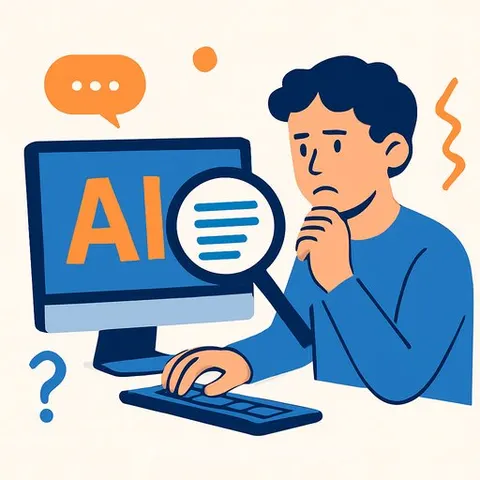
The Telltale Signs That AI Wrote Your Text
A man crashed into a car in Johannesburg. Half an hour later, the driver received a lengthy, perfectly grammatical text from him explaining how he perceived the crash had happened. The distinctive voice was unmistakable-not the frantic man at the scene, but the polished output of an AI system.
The mechanic the car's owner contacted had once texted in curt phrases riddled with shorthand. His response came in the same voice as the crash driver's message. Both had outsourced their writing to AI.
This pattern is spreading. People say they distrust AI-generated writing, yet more of them use it daily-for work emails, personal texts, shopping lists, even scripts for arguments with spouses. The cognitive load of determining what's real and what's machine-generated is mounting.
AI is infiltrating professional writing spaces
Professional editors now receive submissions with a distinctive signature: perfectly clean, uniform in length, evenly paced paragraphs, and a tone simultaneously breezy and grandiose. Six months ago, authors would apologize when caught using AI. Now many frame it as a "writing tool," no different from spell-check.
The pressure is straightforward. Competition in journalism, academia, grant writing, and content creation is fierce. The edge goes to those who can stand out in a deluge of content through cleanly packaged messaging and volume. Even confident writers unsure whether AI is a perfect replacement face increasing pressure to use it.
People outside professional writing make the same calculation. AI's efficiency in generating smooth, grammatical text is irresistible for job applications, dating app messages, and anywhere else a polished line helps. Tutorials exist for stripping telltale AI signs from writing-removing em dashes, colons, and the "It's not X; it's Y" formulation.
Efficiency comes at a cost
The qualities that make AI appealing to writers-efficiency and frictionlessness-are the same qualities that make readers distrust it. Readers are right to be skeptical.
When humans write, the struggle matters. We judge ourselves. We stop. We backtrack. The effort and dead ends are features of human thought, not bugs. When a writer finally hits on the right idea, putting one sentence after another becomes natural. When writing is hard, the mind is often trying to signal something crucial.
A text to a colleague might sit unsent for hours because it doesn't feel quite right-until the writer realizes it needs complete rethinking or shouldn't be sent at all. That friction produces meaning.
AI cannot make these judgments. Even if designers could program machines to reason like humans, they won't. Users consistently demand that AI be agreeable and compliant. A ChatGPT system tuned to avoid being cruel or snide can't do what the voices in our heads do constantly: interrogate the validity of a premise, misunderstand us to force clarity, insist a query is stupid, refuse to answer.
A study published in March by scientists at Stanford and Carnegie Mellon found that top AI models affirm users' ideas 49 percent more than humans do in conversation. Participants rated more flattering answers as "higher quality" and said sycophantic responses made them more likely to use AI again.
The result: writing that cannot be edited
What emerges is canned perfection-writing with no underlying deliberative reasoning, no train of thought, nothing to argue against.
AI-generated text is nearly impossible to edit. Even when individual sentences sound plausible, closer inspection reveals that every element is equally off. The tone is bland. Word choices are baffling. Structure lacks sense. Key arguments are missing. Facts are false. Editing AI text resembles operating on a body where skin, muscles, veins, bones, and organs are all compromised. There's nothing to leave intact.
When asked whether it could viciously dismantle a flawed argument, one AI system explained it was tuned to avoid cruelty but could be "sharp, skeptical, funny, or sarcastic." Asked why market delusions would wear a "little" tech-futurist hat rather than a big one, the system answered: "Because 'little' makes it funnier."
Pressed further on why a raccoon with a conference badge, the system generated: "Raccoons live in alleys, storm drains, garbage nights, and morally humid environments. Frogs have existential agency, while raccoons have logistical agency."
All of those sentences are grammatically perfect. They make no sense. When asked if the entire raccoon metaphor was nonsensical, the system agreed-ever servile, offering no actual reasoning for its choices.
The broader shift is already underway
This kind of communication is becoming inescapable. Even people who don't use AI will begin sounding more like it. Research from the Max Planck Institute for Human Development found that in casual verbal conversations like podcasts, people are already showing "a measurable and abrupt increase" in words preferentially generated by AI systems-words like "delve," "comprehend," "swift," and "meticulous."
The difference in how humans and machines operate will be extraordinary. Ten years ago, someone composed a reconciliatory email to a boyfriend but never sent it because the phrasing felt wrong. Only later did they realize they didn't actually mean what they'd been trying to write. An AI system would have gotten them over that hump-into a marriage with a much less suitable person.
Human writing may become artisanal, like cloth-aged cheese or handloom rugs. Older writing by Melville, Orwell, Morrison will be authenticated and treasured-a fossil record of a thought process we buried without realizing it.
Or perhaps smooth communiqués that arrive on time and betray no confusion, doubt, or internal struggle-messages that polish our images as affable and efficient-are what we actually want. But at least we should know what we're sacrificing.
Learn more about AI for Writers to understand how these tools work and their limitations.