
AI news ·
Airbnb CEO says middle managers are next to lose jobs to AI
Airbnb CEO Brian Chesky warns middle managers face displacement as AI writes 60% of the company's code, shrinking the need for coordination layers. Managers who can't do hands-on work risk being cut.
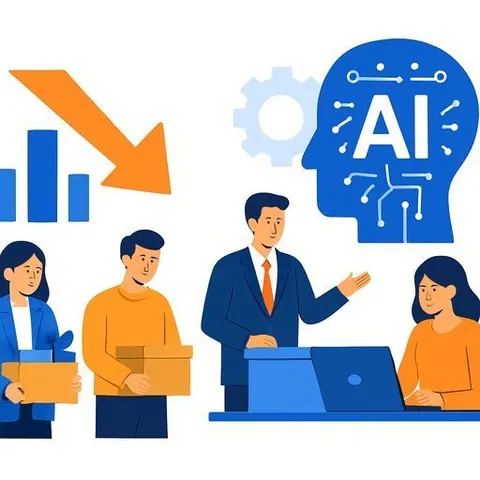
Airbnb CEO warns middle managers face displacement from AI
Middle managers are becoming expendable as tech companies flatten their organizational structures and push remaining managers to write code and lead hands-on, according to Airbnb's leadership. The shift reflects how AI is reshaping who companies need in management roles.
Airbnb now has AI writing roughly 60% of its code. That acceleration in development speed is forcing executives to rethink how many people they need between senior leadership and individual contributors.
The pattern extends beyond Airbnb. Tech firms across the industry are reducing management layers as AI handles routine work that previously required oversight. Managers who don't transition into individual contributor roles-writing code, shipping features, solving problems directly-risk obsolescence.
What this means for your role
If you manage teams in tech or any knowledge-work function, this signals a clear direction: your value now depends on your ability to do the work itself, not just coordinate others doing it. The traditional middle manager who only delegates and reviews is losing ground.
Companies are betting that AI can handle many coordination and quality-assurance tasks that once required a management layer. That leaves managers who can still contribute technically or strategically in demand. Those who can't are redundant.
This isn't confined to engineering. Product managers, business development managers, and operations leaders face similar pressure to become hands-on contributors rather than pure coordinators.
The practical shift
Organizations are flattening because AI reduces the friction that once justified middle management. When code review, documentation, and routine problem-solving happen faster with AI assistance, you need fewer people to supervise and coordinate those tasks.
For managers, this means learning to work alongside AI tools in your domain. Whether that's code, analytics, or strategy, the expectation is clear: you'll need to demonstrate competence in the actual work, not just the management of it.
The companies making this transition now are signaling what others will likely follow. If you're in a management role, the question isn't whether your organization will change-it's how quickly you'll adapt to doing more of the work yourself.
Learn more about AI for management roles and how to stay relevant as organizations restructure around AI capabilities.