
AI news ·
AI's energy and water demands put insurers on alert as data centre risks mount
AI's energy and water demands are reshaping how insurers assess data centre risk. A single ChatGPT query uses several times more electricity than a web search, and large AI facilities can consume millions of litres of water annually.
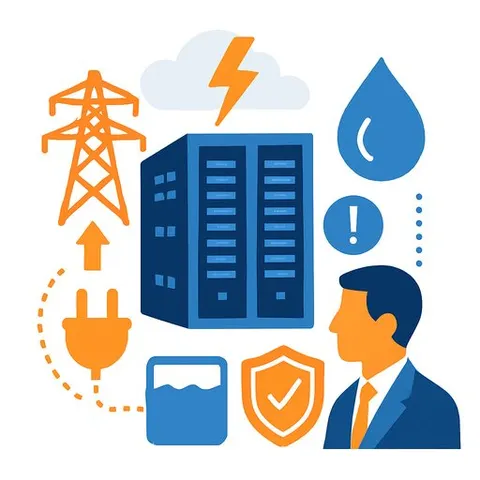
AI's environmental cost is becoming an insurance problem
Insurers are confronting a mounting risk: artificial intelligence's hunger for energy and water is reshaping the risk profile of data centres and technology infrastructure worldwide.
Each query sent to a generative AI tool like ChatGPT consumes several times more electricity than a traditional web search. With billions of AI prompts processed daily, the cumulative effect is material. Studies show that training and operating large language models can consume millions of litres of water annually at a single facility.
Insurance group Everywhen has flagged the issue directly: "If we continue to use AI at the current rate, it will put a significant strain on our natural resources."
Data centre concentration creates new exposures
High-value data centre campuses are clustering around a limited number of power grids and fibre routes. This concentration changes how underwriters assess property and business interruption risk.
Traditional perils-fire, equipment breakdown, natural catastrophe-remain relevant. But now underwriters must evaluate how AI-driven utilisation affects load profiles, cooling requirements and operational resilience. A single outage in a concentrated data centre region could disrupt multiple clients simultaneously.
Carriers are also scrutinising the carbon intensity of the power mix feeding these facilities, which feeds into wider ESG discussions as insurers weigh their own net-zero commitments against expanding AI capacity in their portfolios.
Water use emerges as material risk
Modern data centres depend on intensive cooling systems. Many rely on significant volumes of freshwater, both on site and indirectly through power generation.
A substantial portion of global data centre capacity sits in water-stressed regions. During droughts or heatwaves, operators face potential constraints on operations or forced shutdowns. Regulatory and social pressures follow if operators are perceived to worsen local shortages.
This creates additional liability exposure. Directors' and officers' claims may arise if disclosures around water use, cooling strategies or "green AI" marketing are challenged.
Regulation is tightening disclosure requirements
The European Union's AI Act and parallel measures on data centre reporting are expected to increase transparency around power use, cooling methods and emissions. In the US and other major markets, securities and prudential regulators are moving toward more detailed climate and technology risk disclosures for large corporates and financial institutions.
These developments directly influence liability and regulatory investigation exposure for clients, particularly in directors' and officers' and professional indemnity lines. Standardised data on energy and water use can now feed into underwriting and risk engineering decisions.
AI adoption spreads beyond tech companies
Most large organisations now use AI in at least one business function. Adoption is climbing among small and mid-sized enterprises as models become easier to access via cloud platforms.
Manufacturing, financial services, logistics, healthcare and retail clients are all driving higher demand for compute. AI's environmental impacts are no longer confined to a handful of technology giants.
Sovereign AI concentrates risk geographically
Many countries are exploring "sovereign AI"-systems designed, built and governed nationally to retain control over security, data handling and energy sourcing. In practice, this can encourage national or sector-specific cloud regions backed by government support.
The risk: sovereign AI strategies may concentrate large amounts of compute capacity, energy demand and water use in particular jurisdictions or metropolitan areas, amplifying geographic concentration risk.
Insurers are updating underwriting practices
Carriers are revising proposal forms and risk surveys for data centres, cloud providers and AI-intensive corporates to capture detail on energy mix, cooling technology, water sources and local climate exposures.
Some insurers are exploring how to support risk-reducing investments-waste-heat reuse, advanced cooling, relocation to less water-stressed regions-that strengthen the insurability of AI infrastructure.
Climate and AI regulation is being monitored closely. New disclosure requirements could expose boards to claims if AI-related environmental impacts are under-reported or mismanaged. For AI for Insurance professionals, this means environmental sustainability is now a material underwriting consideration, not a peripheral ESG concern.