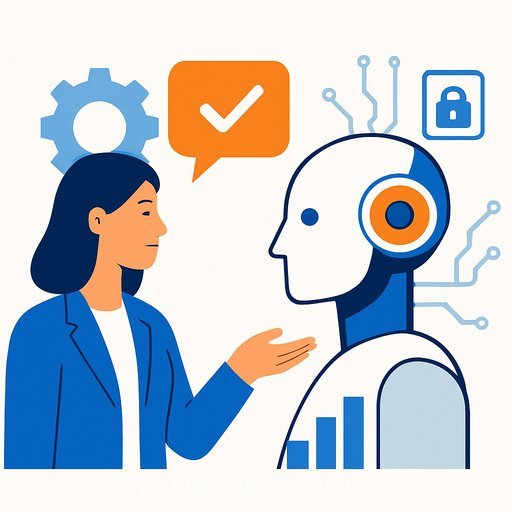
AI Is a People Transformation: What HR Needs to Do Now
AI isn't replacing your people-it's amplifying them. As one panelist at CES put it, artificial intelligence should "accelerate" and "amplify" intelligence. The machine helps, but judgment stays human.
Here's the real shift: technology is moving fast, but the decisive work is human. Culture, skills, trust, and clear strategy will determine whether AI lifts performance-or creates friction.
AI as Amplification, Not Opposition
"Fundamentally, this is a people transformation," said Salesforce's chief equity and engagement officer, Alexandra Siegel. AI will become as normal as email or mobile. You won't need a class to click the tool-but how we work will change, again.
GitLab's Sherida McMullan nailed the mindset: "It's not AI versus the human, it's an amplification." Keep humans in the loop for judgment, ethics, decisions, and trust.
Put HR in the AI Strategy From Day One
If HR isn't at the table early, you'll end up rebuilding the strategy later. AI impacts org design, skills, culture, and how performance is measured. That's your lane.
- Co-lead AI governance with legal, security, and product. Define acceptable use, risk tiers, and human review points.
- Map where AI fits into workflows and where it doesn't. Prioritize high-value, low-risk use cases first.
- Update performance frameworks to value outcomes, experimentation, and learning-not activity volume.
- Build change management into every rollout: comms, enablement, feedback loops, and clear escalation paths.
Business-unit leaders will also need practical guidance on org design and cross-functional governance-see the AI Learning Path for Business Unit Managers for role-specific governance and leadership skills.
Skills That Matter: Fluency + Human Advantage
Siegel emphasized that most employees will need to be "AI fluent," but the differentiators are deeply human: agility, curiosity, storytelling, and creativity. These are the multipliers.
- Create a skills map: AI fluency for all; advanced skills for select roles; leadership capabilities for managers.
- Use role-based learning paths: prompts for knowledge work, data literacy for analysts, QA for legal/compliance, and workflow design for ops.
- Coach for thinking quality-asking better questions, interpreting outputs, and making decisions with uncertainty.
If you're building an upskilling plan, explore the AI Learning Path for Training & Development Managers for practical, role-based programs your teams can apply on the job.
Culture Is the Force Multiplier
Salesforce's AI fluency framework centered on engagement, activation, and expertise. The proof point: employees who felt included and engaged were 58% more likely to feel confident using AI.
- Build trust: communicate where data goes, how outputs are audited, and how employees are protected.
- Create safe sandboxes: let people try tools on non-sensitive work, with quick feedback and peer demos.
- Reward initiative: recognize real use cases, not just slide decks. Share playbooks openly.
Recruiting and Mobility for the AI Era
Samsung's Michelle Manglal-Ian asked the questions every company should answer: What talent are we hiring? What skills matter now? What expertise gaps will block our future vision?
- Revise job descriptions: emphasize problem-solving, learning agility, and comfort with change.
- Source for curiosity and communication. Train for tools. Promote from within where context matters.
- Offer reskilling paths: short, applied learning that ties to projects, not abstract theory.
Governance, Ethics, and Human-in-the-Loop
Responsible AI builds trust and speeds adoption. It also protects your brand and your people.
- Adopt clear AI principles and usage policies. See examples from responsible technology programs.
- Define human checkpoints for sensitive decisions: hiring, pay, performance, legal, and customer-impacting output.
- Measure bias and quality across models. Red-team critical workflows before scaling.
- Educate managers to review AI-assisted work with higher standards, not lower.
Practical Plays You Can Run This Quarter
- Stand up a cross-functional AI council with HR co-leading. Publish a simple playbook and acceptable-use policy.
- Pilot 2-3 AI use cases per function with clear KPIs (time saved, error rates, output quality).
- Launch an AI fluency program for managers first, then teams. Use short sprints and real work examples.
- Integrate inclusion efforts into AI adoption: mentorship, office hours, and peer cohorts to build confidence.
- Update job architectures and career paths to reflect new skills and AI-assisted roles.
The Moment Calls for HR Leadership
The change isn't tomorrow. It's here. If we don't give people the tools-and exposure to AI and agentic technology-we're not doing our jobs as leaders.
Executives should set the strategic guardrails and governance tone from the top; the AI Learning Path for VPs of Strategy can help align strategy, risk, and investment priorities.
Keep people at the center. Treat AI as an amplifier. Build trust, build skills, and build the environment where better work can happen, faster.
Your membership also unlocks: