
AI news ·
Amazon designs its own AI chips for Echo and Fire TV
Amazon is building custom chips for Echo and Fire devices to process AI locally. Its new wearable roadmap includes $49.99 voice-enabled wristbands from its Bee acquisition.
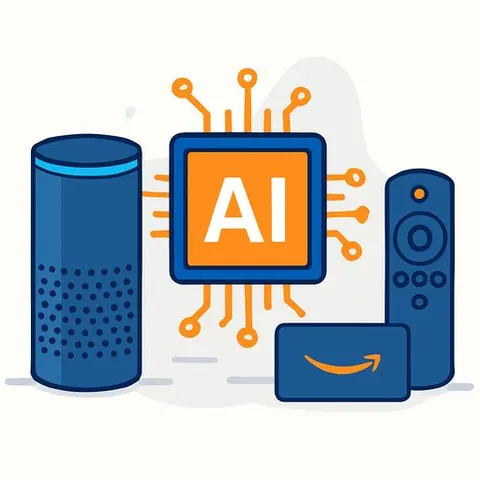
Amazon is building its own end-to-end chips for key consumer devices, its hardware chief Panos Panay said, a move that will let the company run AI features locally and strengthen the link between hardware and software. The custom silicon is already inside products like the Echo Show 8 and Fire TV, and the company has a roadmap for wearable, "on-the-go" gadgets coming soon.
Custom silicon in current devices
Panay, Amazon's senior vice president of devices and services, told CNBC's "The Tech Download" podcast that "we do make our own end-to-end silicon for the devices that we ship." He said Amazon's custom chips are in devices such as the Echo Show 8, Echo Show 11 and Fire TV. The decision to design chips in-house mirrors strategies at companies like Apple, giving consumer electronics firms more control over hardware and software integration. For Amazon, that integration is critical to delivering a secure, ambient experience in the home. This approach is a practical example of AI for Product Development, where tightly coupled components can accelerate device performance and user experience.
On-device AI for speed and security
In October, Amazon unveiled the AZ3 and AZ3 Pro chips, designed to run AI models directly on devices instead of in the cloud. Panay said that for "critical" devices, the focus is end-to-end silicon because "if you really want that hardware and software connection ... and if we're going to deliver this ambient experience in the home for people in the most secure way, we definitely need to think about how that end-to-end delivery of hardware comes together." Many manufacturers see on-device processing as faster and more secure. Running AI workloads on local hardware, rather than relying on cloud inference, is a growing concern for AI for IT & Development teams tasked with ensuring low latency and data privacy.
Future devices and the Alexa+ ecosystem
Panay hinted at a shift in user interaction. "I think we might be moving away from a world of apps and screens," he said, adding that conversation and context will matter more for AI assistants. Amazon launched Alexa+ for general availability in the U.S. this year, an advanced assistant that learns context and ties together Ring, Echo, and Fire TV. The company also made a wearables push with the acquisition of Bee, which makes $49.99 voice-enabled wristbands. Panay said there is a "whole roadmap of on-the-go devices" that people carry, talk to, and that collect data to keep context consistent when returning home. "You won't have to wait long" for such a product, he said. Amazon still uses chips from companies like Qualcomm in some devices, and last month Qualcomm's CEO said the company was working on 40 new AI-powered devices.
Why this matters for product and development teams
Amazon's shift to custom silicon and on-device AI signals a broader industry move toward integrated hardware-software design. For product managers and developers, optimizing AI models for specific hardware can reduce reliance on cloud APIs, cut latency, and improve battery life for wearables. IT teams will need to assess how on-device processing reshapes data flows, security models, and device management. As assistants like Alexa+ become more contextual, the data architecture behind them will demand stronger skills in edge AI and local inference.