
AI news ·
Ancient writers suggest AI generates text but does not truly write, scholar argues
A writing professor coined "generwrite" to separate what AI produces from human writing. Unlike AI text, human writing emerges from lived experience and aims to move people and create change.
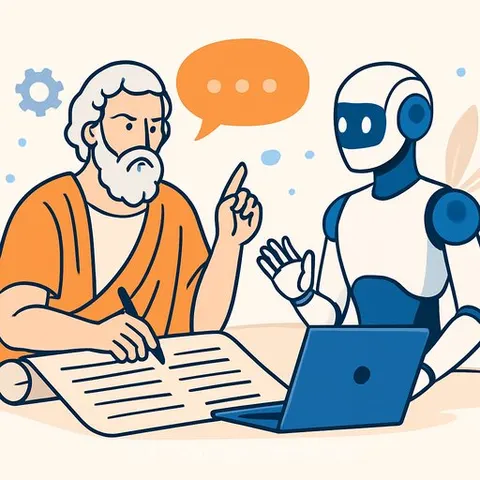
AI Can Generate Text, But Is It Really Writing?
A writing professor and her ChatGPT settled on a new word: "generwrite." The term distinguishes what AI produces from what humans do when they write.
The distinction matters. Most people think of writing as putting words on a page. But writers across 4,000 years have defined it differently - as a medium that expresses lived experience and creates change in the world.
What ancient writers understood
Enheduanna, a priestess and poet around 2,300 B.C.E., wrote hymns and pleas to the Mesopotamian goddess Inanna. In "The Exaltation of Inanna," she praised the goddess strategically, then pleaded for help against a rebel king who had exiled her from her temple post.
The poem worked. Historical records suggest Enheduanna was restored to her position. But more importantly, her writing merged two goddesses - the Sumerian Inanna and the Akkadian Ishtar - into a single "Queen of Heaven." This act of writing created religious and political unity across an empire.
For Enheduanna, writing was not information transfer. It was a living medium that moved hearts and shaped futures.
Plato and Aristotle, writing 2,000 years later, reached similar conclusions. Plato defined writing as a tool for leading learners toward truth. Aristotle called rhetoric "a way of moving souls," not just exchanging knowledge.
Plato's dialogues changed readers' minds so thoroughly that Western universities still call themselves "Academies" after his school. Aristotle's work shaped philosophy for 2,500 years. Both men proved that writing transforms - it doesn't merely inform.
What AI text lacks
AI tools generate text from data aggregation, not from thoughts or lived experience. AI for Writers can produce grammatically correct sentences, but those sentences lack the emotional foundation that makes writing move people.
A study led by computer science professor Natasha Jaques found that heavy use of AI risks what she calls "blandification" - writing that sounds the same across all outputs. When all writing sounds alike, thinking becomes alike too.
People also prefer human writing even when AI writing is stylistically similar. Studies show a consistent "AI penalty" - readers trust and value words written by other humans more than words generated by algorithms.
A new vocabulary
The term "generwrite" captures what AI actually does. It generates text. It doesn't write in the classical sense - it doesn't emerge from experience, it doesn't aim to move souls, and it doesn't create the kind of change that Enheduanna, Plato, and Aristotle described.
Terms like "synthetic text" and "generative content" exist, but they're clunky. A simpler word helps writers and readers recognize a real distinction.
AI isn't disappearing. But new vocabulary can help separate types of text. And as three ancient writers remind us, some qualities of writing may always belong only to thinking beings with real experiences trying to change the world.