Argonne launches AI inference service for researchers across DOE labs
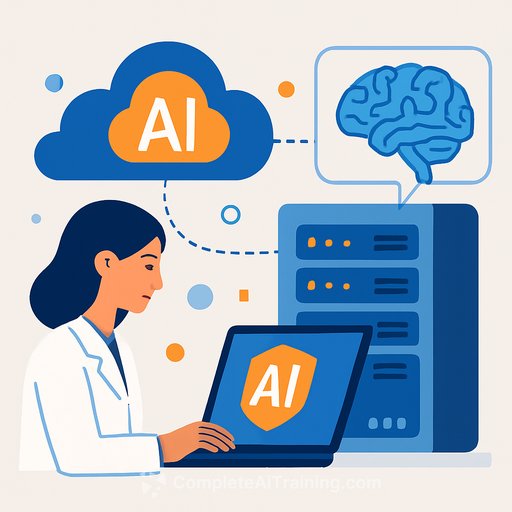
The U.S. Department of Energy's Argonne National Laboratory has opened a shared AI inference service that gives researchers access to large language models and foundation models running on the facility's supercomputers. The service eliminates the need for individual research teams to build and maintain their own AI infrastructure.
Inference-the process of using trained AI models to analyze data and make predictions-is now available to scientists at eight DOE national laboratories, including Brookhaven, Fermi, Los Alamos, Lawrence Berkeley, Lawrence Livermore, Oak Ridge, Sandia and Thomas Jefferson National Accelerator Facility. Researchers log in with their home institution credentials.
The service runs models including Google's Gemma, Meta's LLaMA, OpenAI's GPT-OSS family, and Argonne's own AuroraGPT. It also includes domain-specific models for computer vision and other applications.
How it changes research workflows
In practice, inference lets scientists skip weeks of data analysis. Instead of managing models themselves, researchers can rapidly interpret results, refine experiments and explore complex systems that weren't practical to study before.
In fusion energy, AI models analyze experimental data streams in real time to predict plasma disruptions before they happen. In high energy physics and astronomy, the service helps scientists sift through massive datasets from colliders and telescopes to identify rare events.
Chemistry researchers are using the service with ChemGraph, an AI framework that automates molecular simulation workflows. The system breaks complex, multi-step tasks into smaller steps by having the AI model interact repeatedly with simulation tools-a capability called "tool calling."
"This allows scientists to explore more candidate molecules, iterate on designs faster and manage large-scale calculations as an integrated process rather than a series of disconnected jobs," said Murat Keçeli, a computational scientist at Argonne who helped develop ChemGraph.
Supporting the Genesis Mission
The service is a key component of the DOE's Genesis Mission, a national initiative to build a scientific platform for accelerated discovery. It will also serve as a tool for the American Science Cloud, which integrates DOE supercomputers, experimental facilities and data resources.
The inference service grew from a 2025 framework for secure, scalable AI on high-performance computing systems. It runs on Argonne's Sophia and Metis systems, with plans to expand to the facility's new NVIDIA-based systems, Tara and Minerva.
The service is part of the Argonne Leadership Computing Facility's broader Service-Enabled Science program, which combines HPC and AI resources, workflow tools, model training and large-scale data sharing into a single environment.
For more information, see the ALCF user guide or watch the webinar "Deploying Inference Services at ALCF."
Related learning: Generative AI and LLM | AI for Science & Research
Your membership also unlocks: