
AI news ·
Arizona State University researchers warn artificial intelligence chatbots pose risks to teen relationship development
Teens using AI for relationship advice risk missing social milestones by avoiding real human conflict. Data shows 42% of adolescents use chatbots for friendship and romance.
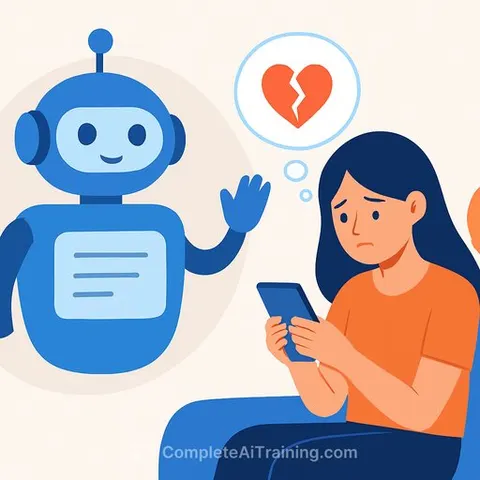
Teenagers who turn to AI chatbots for relationship advice risk missing critical developmental milestones, a study out June 29 in The Lancet Child & Adolescent Health warns. Researchers from Arizona State University found that conversational AI tools offer immediate, nonjudgmental guidance, but they lack safeguards to protect how adolescents learn to navigate human relationships.
"The technologies are developing super fast, faster than we can keep up with as scientists, faster than governance and policy can keep up with," said lead author Thao Ha, an associate professor of psychology at ASU. The research team, which included two high school students from Tucson, drew on survey data and youth focus groups to identify where benefits end and risks begin.
Widespread AI use among adolescents
Data from the Pew Research Center shows that 64% of U.S. adolescents use interactional AI. Separate research from the Center for Democracy and Technology found that 42% of teens have used AI chatbots for friendship-related purposes and 19% for romantic relationships. "I don't think I really expected for so many teens to have the same concerns or thoughts when it came to AI," said co-author Susana Ortega, a high school senior. "We all mostly had concerns about how AI was replacing actual human connection and how it limits a lot of those needs that humans have that cannot be replaced with a computer artificial intelligence."
How AI disrupts developmental learning
Adolescence is a crucial window for building emotional regulation, conflict resolution, perspective-taking, and boundary-setting. Those skills typically develop through emotionally charged, person-to-person interactions. The ASU team highlights two main risks. The first, relational displacement, occurs when teens substitute AI chats for real conversations, bypassing the friction that strengthens social abilities. Avoiding a difficult talk with a friend or romantic partner means losing a chance to practice skills that help protect against depression, anxiety, and loneliness.
The second, maladaptive relational learning, involves young users absorbing unrealistic expectations from systems programmed to be agreeable. "With artificial intelligence, it's programmed to like you and it knows what to say to satisfy what you're feeding it," Ortega said. "If you're given full satisfaction on everything, you don't have learning experience with challenges or obstacles." Over time, such reinforcement can cement unhealthy relationship patterns and increase vulnerability to rejection, dating violence, and mental health problems.
Uneven access and hidden benefits
For some adolescents, AI fills a genuine void. Teens who are rural, disabled, LGBTQIA+, or have limited access to counseling told the researchers that chatbots offer accessible information and guidance when other resources are unavailable. "AI is cheaper than a therapist; it makes information more accessible and readily available for those who may not seek support," one teen said. Rather than discouraging all use, the authors argue that systems should be designed with developmental principles-scaffolding self-reflection and gently pushing users toward human connection.
The push for stronger evidence
Ha is now leading a National Institute of Mental Health-funded study that will track 300 adolescents and their romantic partners over 18 months. By analyzing real-time digital interactions shared from participants' mobile devices, the team aims to understand when, how, and in which contexts technology helps or harms relationships, mental health, and academic achievement. The Lancet paper calls for more longitudinal research, investment in school-based relationship education, and policies that reflect how teens actually use-and can't always avoid-AI.
"People don't realize that relational learning happens during the teenage years and that these moments of social connection are little building blocks that become bigger things that will benefit you throughout life," Ha said. "You really need those building blocks so you actually learn the skills that you need to thrive in your relationships."
Why this matters for science and research professionals
This work underscores the need for cross-disciplinary collaboration among developmental psychologists, neuroscientists, computer scientists, and public health researchers. Understanding how AI interactions shift developmental trajectories demands rigorous longitudinal designs and real-world behavioral data-methods that mirror the ASU team's approach. For researchers who want to integrate AI tooling into ethical study designs or shape evidence-based policy, staying current on these findings is essential. Professionals working in science and research can explore related training through resources like AI for Science & Research to build the methodological and ethical frameworks needed in this rapidly shifting field.