
AI news ·
Army Reserve commander teaches public affairs unit to use AI for faster, more effective storytelling
Army Reserve public affairs officers trained April 9 at Fort Dix on using generative AI to produce military news faster while countering enemy narratives. Human sign-off remains required before anything publishes.
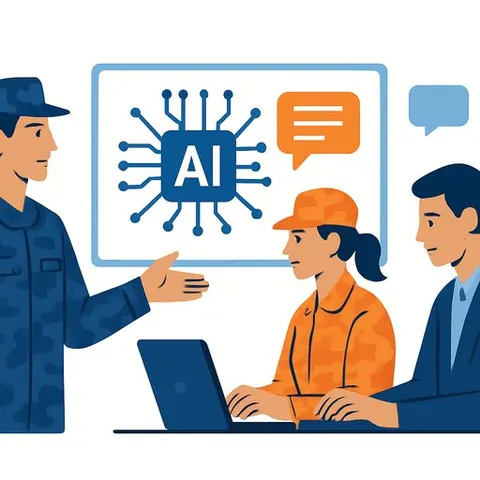
Army Reserve Unit Trains Public Affairs Officers on AI-Powered News Production
Lt. Col. Raymond Ragan, commander of the 361st Theater Public Affairs Support Element, led a class April 9 at Fort Dix, New Jersey, teaching Army Reserve public affairs personnel how to use generative AI to produce news articles faster while maintaining accuracy and security.
The 361st TPASE provides public affairs support to military operations worldwide. The training focused on GenAI, the Department of War's AI platform, and how to use it effectively in countering enemy narratives.
The Speed Problem
Ragan framed the challenge plainly: "We are in a cognitive fight, told through the narrative to support multidomain operations, and the enemy can lie." He cited the old saying that a lie travels halfway around the world while the truth is still putting its shoes on.
Public affairs teams must fact-check messages, verify they don't violate security protocols, and confirm they comply with policy before publishing. That takes time-time the military may not have if adversaries are moving faster.
The Five-Part Prompt Structure
Ragan demonstrated how to write effective prompts for GenAI using five components:
- Persona: Establish the AI as a Defense Information School-trained Soldier
- Context: Provide the information the AI should work with
- Ask: State what you want the AI to create
- Constraints: Specify style requirements, such as AP style or avoiding hyphens and semicolons
- Interview: Have the AI ask clarifying questions before generating output
That final step matters most. The AI may ask questions the user hadn't considered, surfacing gaps or angles worth exploring.
Ragan holds two AI patents and serves as a chief information officer for a startup developing customer service AI, giving him practical experience beyond military applications.
Accountability Remains With Humans
Using GenAI doesn't transfer responsibility for accuracy or security to the tool. Ragan was direct on this point: "Nothing leaves your newsroom that hasn't been personally signed off by someone."
The Army authorizes GenAI use in public affairs but with constraints. Leaders cannot use AI to avoid doing their jobs-only to work more efficiently.
Ragan cited Department of Defense Instruction 5400.19, which covers guiding principles, policy limits, and transparency rules for generative AI in public affairs. The instruction includes a Generative AI Decision Matrix that tells users when they must disclose AI use to the public.
Shifting Attitudes
Staff Sgt. Tyler Matz, a public affairs specialist with the 326th Mobile Public Affairs Detachment, entered the class skeptical of AI. "Before this class, I've always looked at AI as something I don't fully understand and do not want to use," he said.
The demonstration changed his view. He plans to incorporate what he learned into training at his unit.
Pfc. Isabella Youngblood appreciated learning both the constraints and possibilities. She said she now understands how to use GenAI to spark ideas or offer new angles for drafting articles.
The Bigger Picture
Ragan closed by emphasizing that adversaries are moving faster, so the military must too. Speed matters for countering false narratives.
But speed isn't the only goal. He wants AI to "inspire second and third order of innovation." AI tools will only improve. As he put it: "No matter how bad the AI is today, it is the worse AI you will ever use."
For communications professionals looking to apply these techniques, Prompt Engineering Courses and AI for PR & Communications training can deepen practical skills in this area.