
AI news ·
Artificial intelligence changes the insurance claims process for accident victims
Over 70% of insurers use AI for claims. Regulators now require human review for complex auto and medical cases to prevent unfair AI denials.
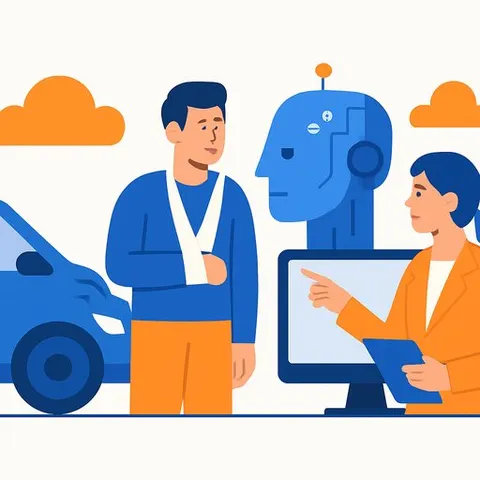
Some insurance claims now begin with a smartphone photo, a telematics ping, or an automated estimate generated before an adjuster sees the vehicle. For the 2.4 million people injured in the 6.1 million police-reported crashes in the U.S. in 2023, according to NHTSA data, that shift is reshaping the weeks after a crash when medical approvals, repair estimates, and settlement offers all hang in the balance.
Artificial intelligence is not limited to chatbots. The National Association of Insurance Commissioners says AI is used throughout the insurance life cycle, including underwriting, pricing, policy servicing, claim management, and fraud detection. In claims specifically, insurers use AI for accident image analysis, estimating ultimate claim settlement values, and flagging suspicious patterns. A 2026 NAIC journal article reviewing insurer surveys found that more than 70% of automobile, homeowners, and health insurers surveyed were already using, planning to use, or exploring AI.
For accident victims, that can mean faster processing in straightforward cases. A damaged bumper, uploaded photos, a police report, and repair-shop data can all be routed through automated systems that identify damage, compare it with historical claims, and generate estimates. But claims after serious crashes are rarely just a repair estimate. They involve medical bills, wage loss, liability disputes, and long-term care needs. Those are the cases where speed may matter less than whether the system accurately weighs the person's full circumstances.
Where automation helps and where it falls short
The clearest benefit of AI is efficiency. Algorithms sort documents, read photos, identify missing information, detect duplicate bills, and route claims to the right department. For insurers handling large volumes of auto, health, property, and liability claims, automation can reduce administrative time. However, the same tools that speed routine steps can create new problems if they influence decisions without enough human review. A model may estimate vehicle damage from a photo but miss hidden structural damage. A claims tool may flag a medical bill as unusual without understanding why a specific injury required additional care. A fraud-detection system may detect a pattern that looks suspicious but has a reasonable explanation.
Insurance regulators have increasingly focused on those risks. The NAIC emphasizes that insurers remain responsible for complying with existing insurance laws when using AI, including rules related to fairness, accuracy, consumer protection, and the avoidance of unfair discrimination. State regulators may require insurers to explain how AI tools are used in claims and other decisions.
Vehicle data is now part of the claims file
Connected cars generate data that can become relevant after a crash: location, speed, hard braking, acceleration, mileage, and other driving behavior. That information may help reconstruct an accident, but it also raises privacy and fairness questions. In January 2025, the Federal Trade Commission announced action against General Motors and OnStar, alleging the companies failed to clearly disclose that they collected precise geolocation and driving-behavior data and sold it to third parties, including consumer reporting agencies, without consumers' consent.
The FTC finalized its order in January 2026, barring GM and OnStar for five years from sharing consumers' geolocation and driving behavior data with consumer reporting agencies. The order also requires stronger consumer control, including consent requirements and the ability to access or delete certain data. The FTC's complaint alleged that some consumers discovered the data sharing only after adverse action notices from insurance companies indicated their coverage was denied, canceled, or their premiums increased because of driving-behavior reports.
For insurance professionals, the case signals that a claim may now involve layers of data generated before, during, or after a crash-some of which the driver may not realize exists. Handling such claims requires understanding where that data comes from, how it is used, and what disclosures are required.
Medical claims face their own AI guardrails
Crash-related insurance claims often overlap with medical coverage. An injured person may be dealing with auto insurance, health insurance, disability coverage, or Medicare Advantage. AI is increasingly part of those systems, too. In February 2024, the Centers for Medicare & Medicaid Services clarified that Medicare Advantage plans may use algorithms or AI tools to assist with coverage determinations, but those tools cannot replace the required review of an individual patient's circumstances. CMS said an algorithm's prediction alone cannot serve as the basis for terminating post-acute care services; the patient's condition must be reassessed before services are ended.
California has also moved to limit how AI can be used in health coverage decisions. State guidance issued in 2025 addressed the use of AI, algorithms, and software tools in utilization management following the passage of SB 1120, which requires health plans and disability insurers that use these tools to meet specific standards. Those health-coverage rules do not govern every auto or personal injury claim, but they show the policy direction: AI may assist, but regulators are increasingly wary of systems that deny, delay, or reduce benefits without meaningful review.
The NAIC reports that over 70% of auto, home, and health insurers are already using or exploring AI. As these tools become standard, professionals need to understand both the operational benefits and the regulatory risks. AI for Insurance training resources cover applications in claims processing, underwriting, and fraud detection, helping teams stay current.
Why this matters for insurance professionals
The claims process is becoming more technical and less visible to consumers. A person may not know whether a settlement estimate came from an adjuster, a software tool, a photo-analysis model, or a combination of all three. That lack of transparency matters because claims decisions affect real financial outcomes. A delayed approval can postpone treatment. A low repair estimate can leave a vehicle owner paying out of pocket. A denied medical claim can create debt before liability is resolved. A settlement offer based on incomplete information may not reflect future medical needs, lost income, or long-term impairment.
For insurance professionals, the rise of AI means the documentation and review process must be more rigorous. Photos should be complete, medical symptoms reported consistently, and repair estimates, diagnostic records, wage documentation, and correspondence with insurers carefully saved. Adverse action notices, denial letters, and explanations of benefits may reveal whether a decision was based on driving data, medical necessity criteria, repair estimates, or other factors. The central issue remains: after an accident, the claim should reflect the facts of the crash, the evidence available, and the person's actual losses-not only what a model can infer from a photo, a form, or a data point.