
AI news ·
Asan Medical Center launches private-network AI search system to protect patient data
Asan Medical Center in South Korea has deployed an AI search system that runs entirely on its own servers, with no internet connection. Staff can query clinical guidelines in seconds without sending patient data outside the hospital.
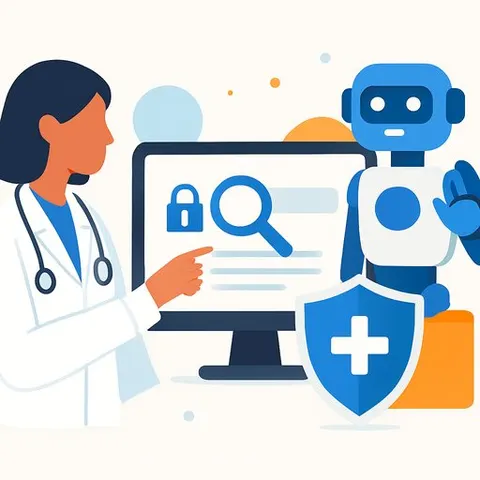
South Korean Hospital Deploys Private AI Search System to Protect Patient Data
Asan Medical Center has launched an AI-powered search system that runs entirely on its own network, disconnected from the internet. The system lets staff retrieve answers to clinical questions within seconds while keeping sensitive data confined to hospital servers.
The hospital built the system using a vector database and retrieval-augmented generation (RAG), two technologies that work together to reduce hallucination-the problem where AI generates confident-sounding but false information.
How the System Works
The vector database converts clinical guidelines, operational regulations, and other documents into semantic units. This approach lets the system search by meaning rather than keyword matching alone.
RAG requires the AI to find and reference stored documents before answering a question. That grounding in actual hospital data makes fabricated answers less likely.
Staff can use the system in time-sensitive scenarios. In emergencies involving endotracheal tube removal or infectious disease reporting, clinicians can respond quickly with evidence-based answers rather than relying on memory alone.
The hospital plans to add a separate external search tool in a "sandbox" environment to access the latest medical information. This addresses a limitation of closed networks: they can't pull real-time data from outside sources.
The Broader Trend
Other South Korean hospitals have built similar systems. Generative AI and LLM technology is becoming standard in clinical settings.
Seoul National University Hospital introduced its medical language model last year, which scored 86.2% on the Korean Medical Licensing Examination. The hospital later released an upgraded version called KMed.ai, developed with Naver, positioning it as a foundation for future medical AI.
Korea University Medical Center also developed its own language model using vectorized data.
Why This Matters for Healthcare
Patient records and clinical protocols are sensitive. Hospitals cannot send this data to cloud-based AI services without legal and security risks.
Asan's on-premises approach shows that AI for Healthcare doesn't require external vendors or internet connectivity. The hospital achieved both data protection and functional AI deployment in a closed environment.
Young-hak Kim, head of Asan's Digital Information Innovation Division, said the system "directly demonstrates that AI can be fully utilized even in a closed network environment."