
AI news ·
Astronomers adopt new protocols for handling alien discovery in age of AI and social media
Scientists have updated SETI's first-contact rulebook to account for deepfakes and viral misinformation. The new protocols require independent verification before any announcement, then immediate public disclosure.
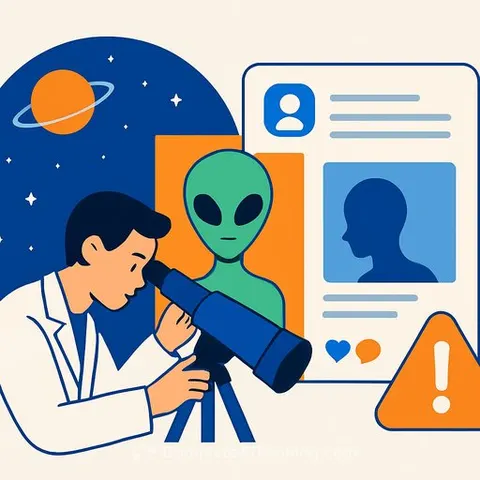
How SETI Will Handle First Contact in an Age of Deepfakes and Misinformation
The International Academy of Astronautics has ratified a rulebook for confirming and announcing the discovery of extraterrestrial intelligence. The updated protocols address a problem that didn't exist when the original guidelines were written in the late 1980s: how to verify a discovery and communicate it to the world when AI deepfakes, social media, and conspiracy theories can spread false claims in minutes.
Michael Garrett, chair of the IAA's Permanent SETI Committee and lead author of the revised Declaration of Principles, said there will be no secret files. "If we ever find a credible signal, the public will know; it won't be hidden away in some government vault," he said.
Verification First, Announcement Second
The discovery process has eight steps. The first is verification - confirming the signal is real and not a misidentification, equipment malfunction, or hoax.
This is the only stage where silence is appropriate. Astronomers must resist announcing findings before independent verification, a discipline that has proven difficult in practice. The first gravitational-wave detection leaked before publication. A candidate SETI signal called BLC-1 appeared in The Guardian before it was published in Nature.
Once verified through independent observation and peer review, the discovery must be made public immediately. The finding goes to the scientific community, the media, and the Secretary General of the United Nations.
The Discoverer May Not Be a SETI Astronomer
Large astronomical surveys like the Vera C. Rubin Observatory in Chile and the upcoming Square Kilometer Array scan vast amounts of data. The person who spots an anomaly indicating extraterrestrial intelligence may be a researcher looking for something entirely different.
That astronomer might not know the protocols. They might post their finding on social media before verification, creating a crisis of credibility before the discovery can be confirmed.
The revised protocols serve as a guide for the unwitting discoverer. They address practical questions: How do you verify the finding? Who do you tell first? How do you handle media attention and social media skeptics?
What Happens After Confirmation
Once a discovery is confirmed, the protocols require protecting the radio frequency from interference, continuing to monitor the signal, and archiving all evidence to prevent future hoaxes.
But the technical work is only the beginning. The IAA will maintain a post-detection committee with members from science, law, ethics, social science, humanities, and communications. Their job is to advise governments, the United Nations, the scientific community, and the public on how to respond.
The protocols do not recommend sending messages to extraterrestrial intelligence without international agreement through the United Nations. The debate over whether to reply at all - known as Messaging Extraterrestrial Intelligence, or METI - remains contentious within the scientific community.
UFOs and the Boundaries of the Protocol
The committee debated whether to include unidentified aerial phenomena, or UAPs, in the protocols. Some members, including scientist Avi Loeb, argued they should be included. The majority disagreed, citing lack of scientific rigor in UFO claims.
The final decision: the protocols cover only phenomena detected above the Kármán Line, the official boundary between Earth and space at 62 miles altitude. This includes alien probes in the solar system or passing spacecraft, but not objects in Earth's atmosphere.
Garrett said the committee's expertise lies in searching for signatures of intelligence beyond Earth's atmosphere. He left the door open for future collaboration on UAP research if it becomes scientifically rigorous.
The Unknown Aftermath
No one knows how humanity will react to confirmed extraterrestrial intelligence. The response could range from widespread panic to collective indifference.
Garrett questioned whether any international organization is truly prepared for the societal and scientific challenges of such a discovery, especially direct contact rather than detection of a distant technosignature.
The protocols aim to establish best practices across multiple disciplines - science, law, ethics, communications, and social science. The goal is to have studied guidelines in place before the discovery happens.
"We would really like to get to a place where we can point to a repository of best practice in a number of different areas," Garrett said. "This is why the protocols were originally set up, and it's why they have been re-drafted, because we think it is important that there's a level of responsibility in the kind of things that we do."
The revised protocols will be presented at the International Astronautical Congress in Antalya, Turkey in October. They are available now on the IAA website.
For writers working with AI systems: As AI becomes more prevalent in content creation, understanding how to verify information and communicate findings accurately mirrors the challenges SETI faces. Learning how to structure requests to AI systems can help you generate more reliable outputs and catch potential errors before publication.