
AI news ·
Attacks on Sam Altman's home signal growing public anger at AI's concentration of power
Sam Altman's San Francisco home was hit by a Molotov cocktail and then gunfire last month. The attacks reflect growing public anger over five people controlling AI tools that will shape the country's economic and social future.
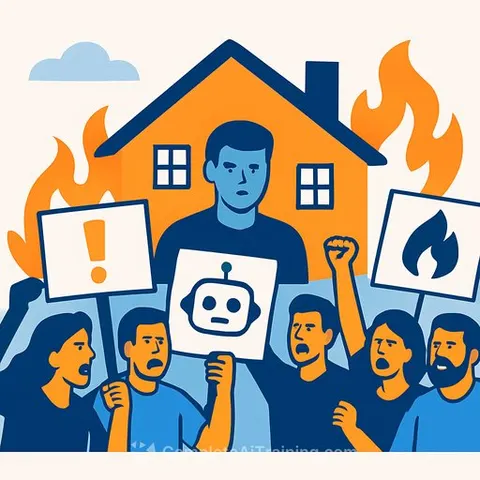
AI Populism Is Here. And No One Is Ready.
The five companies controlling artificial intelligence development now face a political backlash their executives didn't anticipate. Last month, someone threw a Molotov cocktail at Sam Altman's San Francisco home. Days later, his house was attacked by gunfire. The incidents signal a shift in how Americans view the concentration of AI power.
Altman, OpenAI's chief executive, has long worried about existential risks from AI. In 2016, he described prepping for survival with guns, gold, potassium iodide, and a plot of land in Big Sur. That anxiety spawned three of the five major AI labs, each formed because founders feared the others weren't taking risks seriously enough.
What they didn't anticipate was the human response. Americans already protest data centers at town halls over local environmental concerns. They worry about job losses and economic disruption. But the deeper grievance is different: a handful of people now control tools that will shape the country's economic, social, and cognitive future.
The contradiction is stark. AI companies sell a vision of depersonalized systems-superintelligent black boxes making decisions no one fully understands. Dario Amodei, Anthropic's chief executive, acknowledged this last year: "People outside the field are often surprised and alarmed to learn that we do not understand how our own A.I. creations work."
Yet in practice, AI represents the most personalized power grab in recent memory. Five people-Sam, Dario, Elon, Mark, and Demis Hassabis-run systems that will touch every sector of American life. Several are described as sociopaths. None were elected.
For government officials, the challenge is urgent. AI for Government requires understanding both the technology and the political forces now mobilizing against it. The attacks on Altman weren't random violence-they were, as writer Jasmine Sun put it, "A.I. populism's warning shots."
The question facing policymakers is whether they can regulate this concentration of power before public anger boils over further. The window for orderly governance may be closing.
AI for Executives & Strategy courses can help leaders understand the policy and business implications of this shift.