Australian researchers use AI to speed up silicon wafer recycling
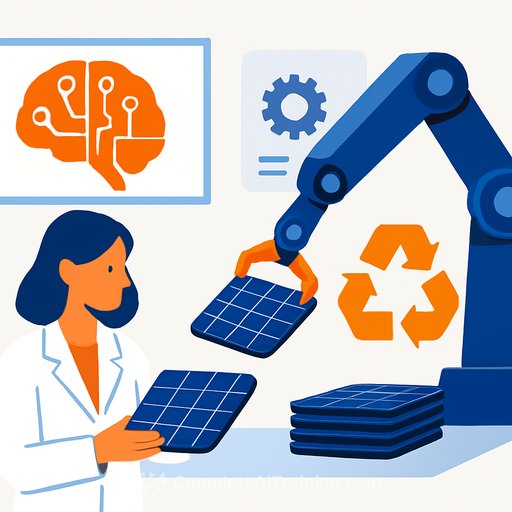
Scientists at the University of New England are using artificial intelligence and supercomputers to identify solvents that can separate silicon from solar panels with minimal contamination-a process that typically destroys the material's purity.
Silicon is the most valuable component in a solar panel but cannot be recycled to its original quality because of the protective substrates applied during manufacturing. The team is running quantum chemical simulations to find molecular formulations capable of cleanly extracting silicon from wafers.
Kasimir Gregory, a computational chemist at UNE, said the approach makes it possible to predict how panels disassemble at the molecular level. "These technologies are giving an exponential boost to the process of scientific discovery," Gregory said.
Autonomous agents accelerate experiments
The research relies on a feedback loop between AI predictions and physical experiments. An AUD 2.7 million automated robotic laboratory, funded by the Australian Research Council and shared across institutions, produces the solvents identified through simulation and tests them in real-world conditions.
Agentic AI agents-autonomous systems that run experiments independently with minimal human oversight-operate the laboratory continuously. This approach compresses development timelines from years to months.
Amir Karton, director of the Australian Institute for Strategic Artificial Intelligence, said the team has created an efficient feedback loop. "This allows us to actively steer the experimental discovery of optimal recycling pathways at unprecedented speeds," Karton said.
Industry partnership and regional focus
Renewable energy developer ACEN Australia is supplying solar panels from its 720 MW New England Solar Project in New South Wales. The company's Stubbo Solar Project recently achieved Circular PV Alliance certification.
David Pollington, ACEN's managing director, said the UNE research represents "an important step in further improving the effectiveness and efficiencies of recycling processes."
Australia is projected to accumulate one million tonnes of end-of-life solar panels by 2035, with a material value exceeding AUD 1 billion. Karton said it is impractical to ship thousands of tonnes of solar waste across the country for processing, making regional solutions essential.
New AI institute launches
On May 7, 2026, UNE launched the Institute for Strategic Artificial Intelligence within LabNext70, Australia's first purpose-built AI research hub focused on education. The institute will work across AI for Science & Research, materials science, education transformation, geopolitical analysis, and strategic decision-making.
Associate Professor Aaron Driver, UNE's chief AI officer, co-directs the institute alongside Amir Karton.
Your membership also unlocks: