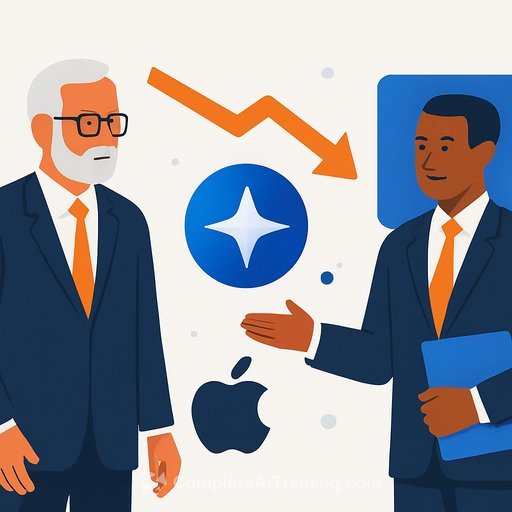
Advise your C-suite on AI's business model impact - not just prompts
For Terence Kok, Chief AI and Innovation Officer at Meinhardt Group, AI starts with people. His track record spans smart city programs across Asia and the Middle East, where digital twins, IoT networks, and AI-driven asset management systems move from slideware to field results. The throughline: multidisciplinary teams, practical execution, and technology that delivers measurable public value.
His message to HR leaders is clear: your organisation doesn't need another tool demo. It needs leadership, data readiness, and a structure that puts employees at the center while reshaping how the business creates value.
People-first AI that actually improves performance
Kok has seen the biggest gains when organisations prioritise Return on Employee (ROE) alongside financial ROI. One law firm gave teams 12 weeks of dedicated GenAI learning time, gamified with "Mintcoins" and badges. They lifted engagement with internal influencers and short "Tech Talks," where employees shared real use cases. The result: learning became contagious, not forced.
When AI saves time, they don't pocket the hours into more busywork. They reallocate that time to self-development or wellness. That shift replaces fear of job loss with growth and fulfillment.
Change that sticks: structure beats slogans
The quickest way to stall adoption is "accidental ownership" by IT. Kok pushes for a deliberate three-way partnership across IT, HR, and Communications. Clifford Chance, for example, built a 35-person transformation team that included change and process experts, not just technologists.
Support must be segmented. Executives need coaching on business model disruption. Middle managers need tools like empathy maps to address anxiety and convert efficiency into value stories. Kok also tracks human-machine friction scores to surface real user pain points. Use those signals to refine workflows, not to blame people.
Fueling creative thinking
Outside work, Kok turns to science fiction. Those stories show both the futures we'd want and the ones we should avoid. "They serve as reflections and warnings, encouraging us to consider how our actions today could shape tomorrow."
Your call-to-action for InteracTech Asia 2026
Stop treating AI enablement like a generic training plan. Buying licenses is easy; the hard part is leadership, data, and operating design. Segment your approach: advise the C-suite on how AI reshapes business models, and equip middle managers to guide people through the change. Go beyond ROI with a Return on Future lens - strategic bets that remake how you win. Don't do this solo; create a shared executive council.
InteracTech Asia 2026 convenes HR leaders, technologists, and business strategists on 20 May in Singapore to rethink how people and machines thrive together.
What HR can do next (starting this quarter)
- Brief the C-suite on business model shifts: Map two to three AI scenarios that affect revenue, cost structures, and customer experience. Highlight risks and opportunities by function.
- Stand up an AI change office: A cross-functional team across IT, HR, Comms, Legal, and Finance. Name a single owner. Set standards for tooling, data, and adoption.
- Run an 8-12 week learning sprint: Allocate protected time, add light gamification, and host internal "show-and-tell" Tech Talks. Curate role-based learning paths to speed momentum. For structured options, see the AI Learning Path for Training & Development Managers.
- Equip managers: Provide an empathy map template, talking points for team meetings, and a simple method to turn saved hours into "value stories" (fewer handoffs, faster cycle times, happier clients).
- Measure human-machine friction: Survey task difficulty before/after AI, review help-desk tickets, and sample session logs to find bottlenecks. Track monthly and publish fixes.
- Reinvest time saved: Set a policy that a portion of AI time savings goes to upskilling or wellness. Make it visible and celebrate teams that apply it well.
- Adopt metrics beyond ROI: Include ROE (engagement, capability growth, mobility) and Return on Future (new products, data assets, and capability flywheels).
- Create a shared executive council: Meet biweekly to approve use cases, data access, and risk controls. Keep decisions tight and documented.
Why HR's role is pivotal
AI shifts how work gets done, how value is created, and how people grow. HR sits at that intersection. Guide leadership on business models, coach managers through change, and make learning a habit across the workforce. That's how you turn tools into outcomes.
Your membership also unlocks: