
AI news ·
Bowdoin professor leads trustworthy AI workshops for finance and legal professionals in Washington, D.C.
Bowdoin Professor Vianney Gomezgil Yaspik led AI training for senior practitioners at the World Bank and JP Morgan. She hosted a risk framework panel for 40 legal professionals.
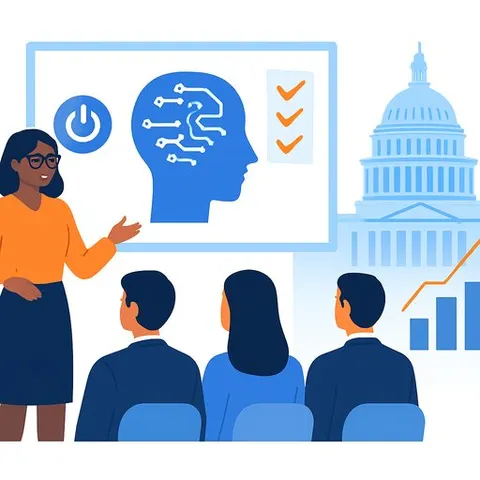
Professor Vianney Gomezgil Yaspik of Bowdoin College recently traveled to Washington, D.C., to lead AI training sessions for senior practitioners at major financial and legal institutions, including the World Bank, JP Morgan, and Wilson Sonsini Goodrich & Rosati. These sessions addressed the operational realities of deploying generative AI tools in high-stakes environments, focusing on workflow integration and risk frameworks rather than vendor marketing.
World Bank consultations and operational realities
The visit began with consultations at the World Bank. Yaspik met with teams designing internal AI systems to discuss workflow integration and risk frameworks. These discussions drew directly on her research into trustworthy AI systems and how default effects influence professional interactions with automated tools. This work will continue during her Summer Data Science Lab with Bowdoin Data Science Fellows.
AI meets legal practice
The second evening event, AI Meets Law, gathered approximately 40 legal professionals from private practice, public interest groups, and multilateral institutions. The panel included Stefan Geirhofer of Wilson Sonsini Goodrich & Rosati, Kevin Bankston of the Center for Democracy & Technology, and Jeremy Ng, Counsel for AI and the Digital Economy at the World Bank. Marshall Maina, Project Finance and AI Legal Counsel at the World Bank, moderated the discussion.
During the second half of the evening, Yaspik mapped the global legal AI environment. She offered attendees a working understanding of how these tools operate beyond marketing language and challenged the group to apply critical thinking to the ethics of widespread deployment. Professionals seeking resources on AI for Legal can use this same rigorous evaluation to move past vendor hype and assess actual operational value in their own firms.
Broader industry context
The AI Collective, a nonprofit with over 150,000 members, hosted both events. The organization states its mission is to "steer AI toward trust, openness, and human flourishing." This Washington programming closed a loop that began on Bowdoin's campus, when AI Collective leader Dr. Elif Nisa Polat traveled to Brunswick to discuss the importance of humanities degrees in the age of AI.
Why this matters for legal professionals
Law firms and legal departments face mounting pressure to adopt generative AI for document review and workflow automation. Deploying these tools without understanding their underlying risk frameworks can expose organizations to compliance and ethical liabilities. Legal practitioners must demand transparency about how AI models function and establish clear default protocols before integrating them into client work. Support staff and paralegals can build this foundational technical literacy through a structured AI Learning Path for Paralegals to ensure safe and effective tool adoption.