
AI news ·
Brooklyn Park Mayor Hollies Winston Champions AI Innovation and Equity in Local Government
Brooklyn Park Mayor highlights AI's role in boosting city efficiency and equity. Education and bias awareness are key to responsible AI use in local government.
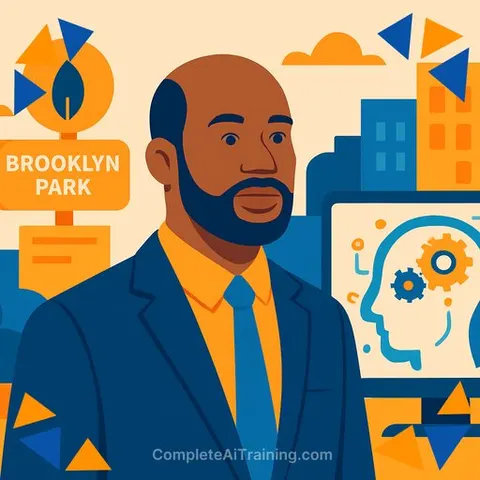
Brooklyn Park Mayor Discusses AI’s Role in Local Government
Brooklyn Park Mayor Hollies Winston recently took part in a roundtable discussion focused on artificial intelligence (AI) and its impact on city governance. Held at the Brooklyn Park Library on April 29, the event brought together eight mayors from across the United States who formed the Community Innovation Partnership (CIP). This coalition promotes the use of AI and emerging technologies to improve city functions and policy development.
Mayor Winston emphasized practical application over hype. “When I use ChatGPT, it’s for advisory purposes,” he said. “But I need to understand qualitative versus quantitative data and some basic scientific principles because AI can go off the rails.” His point highlights the need for foundational knowledge to use AI effectively in government settings.
AI Implementation in Brooklyn Park
As a founding member of CIP, Winston shared how Brooklyn Park is already integrating AI into its workflows. The focus isn’t on replacing employees but on automating repetitive tasks. “Replacing whole streams of work frees up staff to provide better customer service and allows for greater efficiency,” he explained. This expanded capacity helps the city tackle other priorities more effectively.
Educating the Next Generation
The roundtable included local teens from the library’s Teen Tech Squad, underscoring the importance of AI education. Winston acknowledged that while city officials don’t set school curricula, they can support after-school programs and grants to build AI skills. “Kids with AI training and networks will have their own impact,” he said, pointing to the need to prepare youth for AI-driven workplaces.
Addressing Bias and Equity in AI
Taycier Elhindi, a civil rights advocate and featured speaker, raised a critical concern: AI models often reflect existing social biases since they’re trained on internet data. “How do you keep up with checks and balances?” she asked. Brooklyn Park’s population is 64% people of color, making fairness essential.
Winston responded by stressing awareness of systemic issues. “AI assistants operate within systems that drive specific outcomes,” he said. “You have to trace outcomes back to their origins to understand and manage bias.” This approach calls for careful evaluation and ongoing oversight in AI applications.
The Future of AI in Local Government
Michael Halagan, a consultant with Local AI, added that future workplace AI will be job-specific and customized with internal data. “ChatGPT doesn’t know your city’s unique information,” he noted. “The challenge is building AI tools that don’t perpetuate bias.”
Winston sees opportunity as diverse communities gain AI access. “AI can free people who haven’t had first-rate education,” he said. Especially within the African American community, he believes creativity combined with AI can overcome traditional barriers.
Final Thoughts
- AI is already helping cities streamline operations without cutting jobs.
- Foundational education on AI and data principles is key for local government staff and youth.
- Addressing bias requires understanding AI’s systemic influences and monitoring outcomes.
- Customized AI tools will better serve specific city needs while minimizing bias.
- Broadening AI access among diverse populations can promote equity and innovation.
For government professionals interested in expanding AI knowledge, exploring courses in AI fundamentals and ethics can be a practical next step. Resources like Complete AI Training’s government-focused AI courses offer relevant insights to help you lead AI initiatives responsibly in your community.