AI will shrink headcount before it grows it: what HR needs to do now
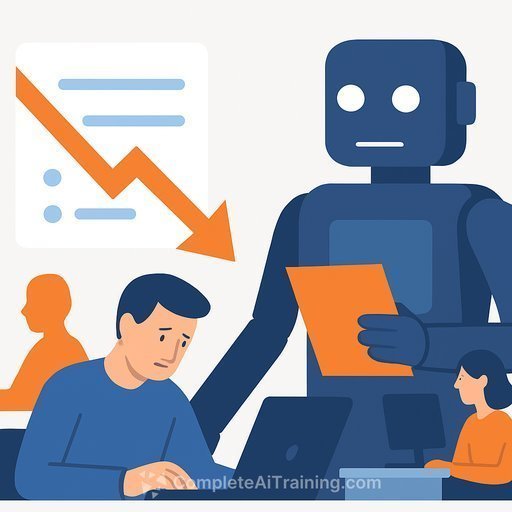
Canada is heading into a J-curve for employment. A new report from the Conference Board of Canada (rebranding to Signal49 Research on Jan. 26, 2026) projects a sharp dip by 2030 as employers automate, followed by steady gains that exceed today's baseline by 2045.
The numbers are clear: an initial drop of 2.6% in 2030 (about 555,000 jobs), with the report also noting employment could sit roughly 535,000 below its 2030 baseline. Longer term, total employment is projected to be 2.1% higher in 2045 - about 535,000 more jobs than the baseline scenario.
Short term, expect pain as organizations reduce workforce in favour of AI. Long term, productivity-driven demand creates new roles and more participation in the labour force, alongside a lower unemployment rate. Explore AI Productivity Courses to see how efficiency gains can be captured and redeployed into growth roles.
Source: Conference Board of Canada
Key context HR should anchor on
- Automation is mostly about tasks, not whole jobs. The report estimates 53% of tasks across Canadian occupations could be performed by current AI.
- Jobs evolve as their most automatable tasks are offloaded. Human-centric work (judgment, relationships, coordination) becomes a larger share.
- Productivity gains don't always mean cuts. If AI halves task time, many employers will double throughput instead of reducing headcount.
What to do in the next 6-12 months
- Map roles to tasks. Flag tasks with high automation potential, then redesign roles rather than defaulting to cuts.
- Freeze smart, not blunt. Prioritize backfill freezes and redeployment before broad layoffs to preserve optionality.
- Fund reskilling now. Prioritize data literacy, AI-assisted workflow design, prompt skills, and process improvement for managers and frontline teams.
- Run targeted pilots. Stand up 3-5 AI use cases with clear metrics (cycle time, error rate, cost per output) and a change plan - lean on AI for Operations practices to validate workflow optimizations.
- Stand up governance. Define approved tools, data use, privacy, IP rules, and audit trails. Train managers on what "good" looks like.
- Create a redeployment marketplace. Match at-risk employees to internal gigs tied to AI-enabled growth areas.
- Update workforce plans quarterly. Treat capacity as variable; model multiple adoption speeds and hiring backlogs.
- Communicate early and often. Be honest about near-term reductions and the path back to growth. Offer learning stipends and clear timelines.
Metrics that matter
- Tasks automated per role and time saved (hours/employee/month)
- Throughput per FTE and quality/error rates after AI adoption
- Internal mobility and redeployment rate for at-risk employees
- Training completion to proficiency (assessed, not just attended)
- Voluntary attrition in automatable roles vs. critical growth roles
- Employee sentiment on job redesign and tool usability
Where the jobs net out by 2045 (winners)
People-facing work that benefits from broader economic growth tends to come out ahead:
- Food-counter attendants, kitchen helpers, and related support: +21,187
- Retail salespersons and visual merchandisers: +20,972
- Transport truck drivers: +15,978
- Nurse aides, orderlies, and patient service associates: +15,318
- Construction trades helpers and labourers: +9,591
Roles with net declines by 2045 (after adjustment)
- Managers in agriculture: -569
- Health policy researchers, consultants, and program officers: -935
- Specialized livestock workers and farm machinery operators: -1,390
- Real estate agents and salespersons: -1,758
- Water and waste treatment plant operators: -5,708
How to handle the J-curve inside your org
- Redesign before you reduce. Remove or shrink automatable tasks, then expand customer-facing, safety-critical, and creative work.
- Buy time with contract mix. Shift a slice of variable work to contingent labour during the dip to avoid over-cutting.
- Tie savings to growth. Ring-fence a portion of AI efficiency gains to fund hiring in validated growth roles.
- Protect morale. Clear skill pathways plus visible internal moves beat vague promises. Publish quarterly progress.
Capability bets for HR to sponsor
- AI literacy for all people leaders (risk, data use, workflow design)
- Prompt and workflow libraries tied to your SOPs
- Tooling standards and secure data access patterns
- Ethics reviews for high-impact use cases (hiring, performance, pay)
- Lean process skills for continuous improvement alongside AI
Bottom line
Expect a meaningful employment dip by 2030, driven by task automation and efficiency plays. Plan for it, cushion it with redeployment and reskilling, and use the savings to fund the roles that will grow.
If you move early on job redesign, skills, and governance, you'll hit the upside of 2045 faster - and with a workforce that's ready for it.
Explore AI courses by job role (Complete AI Training)
Your membership also unlocks: