
AI news ·
Canadian tribunal orders lawyer to pay $31,150 for AI-fabricated citations
A Canadian tribunal ordered a lawyer to pay $31,150 in costs for citing AI-fabricated cases. AI-fabricated citation cases surged from 7 in 2024 to 87 in 2025, with 74 more in 2026.
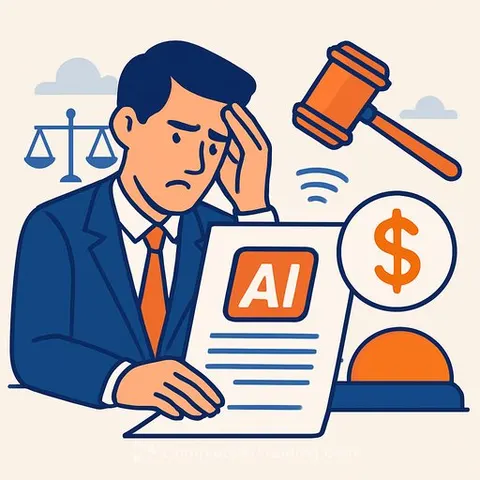
A Canadian tribunal has ordered a lawyer to pay $31,150 in costs after submitting court materials containing case citations fabricated by artificial intelligence - the largest such award issued by a Canadian court or tribunal to date. The penalty arrives as documented instances of AI-generated fake legal citations surge across the country, rising from just seven decisions in 2024 to 87 in 2025, with 74 more recorded in the first six months of 2026 alone.
Nainesh Kotak, founder of Kotak Law and a litigator with more than three decades of experience, sees the problem accelerating. "We're going to see more sanctions when it comes to the filing of documents with AI hallucinations," Kotak said.
Cases multiplying at a record pace
Data compiled by access-to-justice watchdog Courtready show the sharp climb. In 2024, Canadian courts and tribunals saw only seven decisions involving AI-fabricated legal materials. That number jumped to 87 in 2025, and the first half of 2026 already accounts for 74 decisions. Legal observers say 2026 is on track to set a new record for AI-related misconduct in court filings if the current rate holds.
Kotak believes the publicly available figures represent only a fraction of the real total. "These are just the reported cases," he said. "We don't know how many AI-generated citations were accepted without being caught. We don't know how many matters were resolved before sanctions were issued. This could very well be the tip of the iceberg."
Lawyers and self-represented litigants both at risk
Roughly 81 per cent of reported incidents involve self-represented litigants, who may not know that AI systems can generate convincing but entirely fictitious legal authorities. However, nearly one in five cases involve licensed lawyers - meaning more than 30 legal professionals across Canada have already faced sanctions or judicial criticism for failing to verify AI-generated work.
"What we're seeing is people employing AI to help with their practice or their case, but the problem is they need to remember that you can't outsource your duty of accuracy to an AI tool," Kotak said.
AI hallucinations grow harder to spot
Earlier generations of AI-generated errors were often easy to identify - a case name that didn't exist or a quote too outlandish to take seriously. That is no longer true. "What we're seeing today are real-looking citations, real-sounding case names, plausible reasoning and fabricated quotations. It's getting much harder to detect," Kotak said.
The increasing sophistication places a heavy burden on legal professionals to verify every authority they cite. Resources that build AI Training for Legal Professionals skills can help lawyers and staff develop systematic review habits, rather than relying on an AI tool's output as the final word.
Safeguards are in place, but pressure mounts for stricter rules
Ontario courts now require lawyers to certify the accuracy of filed documents and hyperlink authorities cited in court materials. Kotak argues those steps alone won't solve the problem as AI-generated errors become more polished. He calls for mandatory disclosure whenever AI tools are used to prepare legal filings, along with certification that lawyers have personally verified all cited authorities.
His recommendations also include formal verification standards issued by the Law Society of Ontario, judicial protocols for flagging suspected hallucinations, and better protections for self-represented litigants who may not grasp AI's limitations. At the same time, Kotak does not oppose AI's use in law. "If running a successful law firm in today's age, you have to use AI. It just streamlines processes. It's the way of the future, but it has to be done responsibly," he said.
Why this matters for legal professionals
The $31,150 costs award and the rapidly rising volume of AI-fabricated citation cases signal that courts will no longer tolerate unchecked AI use in filings. For lawyers and paralegals, the duty of competence now clearly includes verifying every AI-generated legal authority. The risk is not merely financial - fabricated citations can cause delays, damage professional reputations, and lead to miscarriages of justice. "It's not just a technology issue," Kotak said. "It's a professional obligation and a justice issue. In fabricated cases or quotes that get into court filings, there's real harm, there's delays, there's costs and potential miscarriages of justice." The takeaway is concrete: build verification into your workflow before you file, disclose AI use, and never let a tool substitute for your own professional judgment.