
AI news ·
Capgemini finds executives still wildly overestimate customer trust as AI agents begin to reshape how people search and buy
Most executives think customers would recommend them. Only 45% actually would - a gap unchanged since 2017. Now AI shopping agents are making that blind spot more costly.
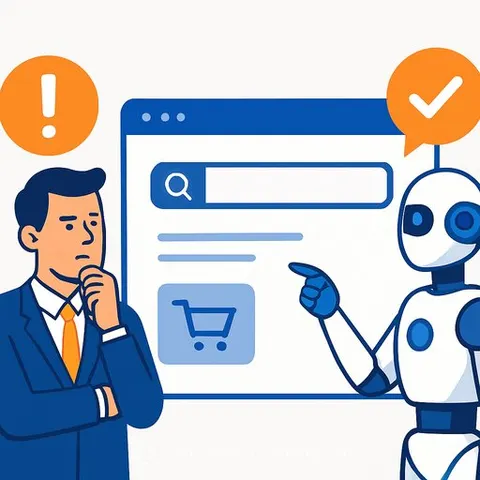
Executives still don't understand their customers. AI is about to make it worse.
A decade of customer experience investment has produced almost no progress. Executives at 84% of companies believe customers would recommend them based on their experience. Only 45% of customers actually would. The gap is nearly identical to what Capgemini found in a 2017 study.
The problem is about to amplify. As AI agents increasingly handle shopping, comparison, and purchase decisions on behalf of consumers, brands that haven't fixed their fundamentals will find themselves competing for machine preference rather than human attention.
Capgemini surveyed 9,500 consumers across 16 countries and 1,200 executives across 13 markets to reach this conclusion. The findings suggest most organisations are unprepared for the shift.
How AI agents are reshaping commerce
Fifty-two percent of consumers already use tools like ChatGPT, Gemini, and Perplexity instead of traditional search when researching products. That number is set to rise after Google's recent announcements.
These agents compress what used to be a sprawling digital journey-search, comparison, review, checkout-into a single conversation. The entire customer journey is contracting.
Retailers are preparing for this shift. Google's Universal Commerce Protocol, Amazon's 'Buy for Me' agent, and Walmart's AI-assisted shopping systems are all examples of companies moving toward AI-to-AI retail environments.
But here's the problem: most organisations can't transfer customer context across channels. Only 28% of companies have systems capable of seamlessly moving conversation history between online and offline channels. Forty percent cite fragmented customer journeys as their biggest barrier to effective experience.
Consumers feel the friction. Nearly two-thirds say they often have to re-explain issues to human agents after chatbot interactions. Seventy-four percent expect access to a human within a minute of using a bot.
The trust gap that executives are ignoring
Eighty-one percent of consumers see data security as a top concern. Only 8% of executives view it as a significant AI risk.
More than 80% of consumers are uncomfortable with AI systems storing personal data without consent. Yet most leadership teams aren't treating this as urgent.
This disconnect matters. When executives underestimate customer concerns, they underinvest in solutions. They miss early warning signals of dissatisfaction.
Why humans remain essential
Automation alone won't fix customer experience problems. The report found consumers continue to rank front-line employees among their preferred channels for engagement, especially in emotionally sensitive or high-stakes interactions.
More than one-third of customers said they would pay a premium for human support. Sixty-nine percent said they could forgive product flaws but not frustrating or impersonal experiences.
ASOS, which handles roughly 5 million customer conversations annually across 150 markets, rebuilt support operations using AI triage systems and advisor-assist tools alongside live-chat-only engagement. Customer resolution rates and satisfaction scores improved despite internal concerns that customers would resist losing phone and email support.
The lesson: AI works best when it handles routine decisions and escalates complex or emotional issues to humans. This is what the report calls a "human-in-the-loop strategy that combines machine efficiency with human empathy."
The new competitive metric: conscious override rate
Capgemini proposes a new measure called "conscious override rate" (COR) may become more meaningful than net promoter scores. COR measures whether consumers care strongly enough about a brand to override generic AI recommendations.
In a world where convenience becomes a commodity, brands must deliver experiences and emotional value strong enough for customers to consciously choose them over what an algorithm suggests.
If a brand doesn't design experiences that empower human override, it's not building a brand. It's simply feeding data for algorithms to optimise away.
What this means for customer support teams
The shift toward AI agents doesn't eliminate the need for support staff. It changes what support staff do.
Customer support professionals will increasingly manage AI triage systems, handle escalations from bots, and focus on interactions that require empathy and nuance. The technical foundation matters: organisations need to optimise for "generative engine optimisation" (GEO) so AI agents can discover and recommend products inside conversational interfaces.
But the human element remains central. Brands that treat support as a cost centre rather than a trust driver will lose customers to competitors who get this balance right.
Learn more about AI for Customer Support and how Generative AI and LLM are reshaping the field.