Carnegie Mellon Pushes Science Diplomacy as AI Reshapes Research
Carnegie Mellon University faculty are stepping into global policy conversations about artificial intelligence and scientific research, arguing that academics must communicate directly with policymakers and the public about their work's importance.
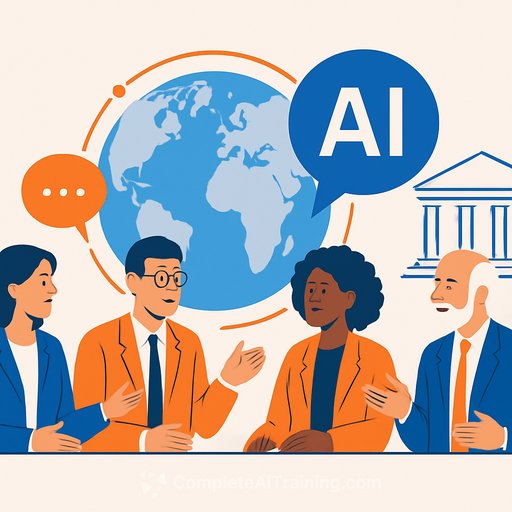
Barbara Shinn-Cunningham, dean of the Mellon College of Science, spoke at a January roundtable organized by the American Academy of Arts and Sciences and the Royal Society in London on science diplomacy. She said scientists have historically avoided policy discussions, treating them as distractions from research itself.
"We need to explain why science matters: how it fuels economies, trains the workforce, mitigates or even cures disease, and helps address existential challenges like climate change," Shinn-Cunningham said.
AI Makes Clear Communication Essential
Shinn-Cunningham noted that artificial intelligence has made scientist-to-policymaker communication more urgent. Modern research produces data at scales humans cannot interpret alone, making AI essential to discovery.
"AI is no longer optional; it is essential to discovery," she said. "As a tool, AI dramatically accelerates discovery, but only when it is grounded in deep domain knowledge, with constraints built into the computation."
She argued that AI systems used in research must maintain the same standards that define scientific progress: rigor, transparency, reproducibility, and accountability. Without these principles embedded in AI tools, trust in scientific findings erodes.
University Leaders Address Global Forums
Carnegie Mellon President Farnam Jahanian participated in panels at the 2026 World Economic Forum, discussing how interdisciplinary education and AI-accelerated discovery prepare workforces for technological change.
"It's not just about educating the next generation of scientists and engineers," Jahanian said. "It's really about developing the population such that we all can benefit from it and can leverage that in their day to day work."
Erica Fuchs, director of the Critical Technology Initiative, moderated discussions on technology policy, manufacturing, and international industry dynamics. She said academia can serve as a neutral third party in an increasingly polarized environment.
"There is tremendous potential for academics between nations to develop a common empirical understanding of the world to inform trade and diplomatic negotiations, policies, and defense alliances within and between nations," Fuchs said.
AI Expertise on International Stage
Ramayya Krishnan, dean emeritus of the Heinz College of Information Systems and Public Policy, attended the 40th Conference of the Association for the Advancement of Artificial Intelligence in Singapore in January. He gave keynote addresses on AI measurement and governance.
Krishnan discussed the gap between AI capabilities and how organizations actually deploy those capabilities. He called on policymakers, legal experts, and business leaders to address governance challenges, particularly around AI agents and questions of accountability.
Stephen Smith, AAAI president and CMU research professor, noted that AI has moved from specialized research into mainstream society. "We've seen some remarkable technical advancements with deep learning and large language models," Smith said. "With that has come raised expectations of both the potential and the concerns about AI."
Former AAAI presidents Raj Reddy and Manuela Veloso also participated in a presidential panel on the future of AI research, discussing how the field must evolve across industries.
Krishnan said these international forums give institutions like Carnegie Mellon the chance to meet global decision-makers where they are. "As we make scientific advances, how we communicate about the future becomes just as important as what we are communicating," he said.
Explore AI for Science & Research or AI Research Courses for professional development in this space.
Your membership also unlocks: