
AI news ·
Chicago journalists and voice actors sue tech giants over AI voice training under Illinois biometric law
Nine journalists, podcasters and voice actors filed class action suits against Google, Amazon, Apple, Microsoft and Meta, alleging the companies used their voices to train AI without consent. The cases invoke Illinois' BIPA law.
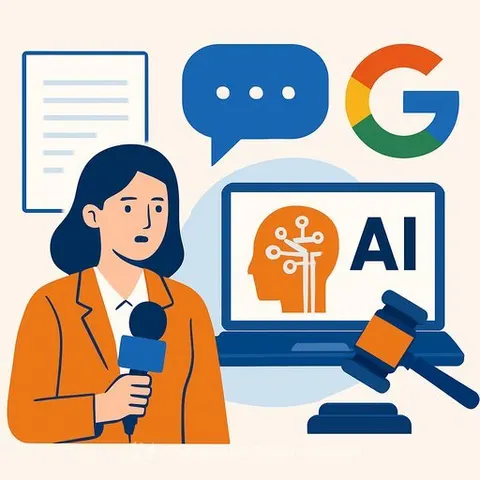
Journalists sue tech giants over use of voices in AI training
Chicago-based journalists, podcasters and voice actors filed nine class action lawsuits this week against Google, Amazon, Apple, Microsoft, Meta and other tech companies, alleging the firms used their voices to train AI systems without consent or permission.
The suits, filed in federal court in Chicago, invoke Illinois' Biometric Information Privacy Act, or BIPA - a state law that has generated thousands of lawsuits and millions in settlements over the past decade. The cases represent the first major push to apply BIPA to voice data used in AI development.
The plaintiffs include retired NBC 5 journalists Carol Marin and Phil Rogers, along with podcast hosts and voice actors including Robin Amer, Lindsay Dorcus, Victoria Nassif, Yohance Lacour and Alison Flowers. All are Illinois residents.
What the lawsuits allege
The complaints argue that tech companies extracted voiceprints - digital representations of individual voices that include pitch, timbre, resonance and speech patterns - from publicly available recordings and fed them into text-to-speech and voice AI systems without permission.
"None of them was told that their voice was being used to train Amazon's commercial voice AI," the lawsuit against Amazon states. "None of them was asked. None of them consented."
The lawsuits characterize a voiceprint as a mathematical fingerprint that cannot be recovered once taken. Unlike a Social Security number, which can be reissued, a person cannot change their voiceprint because it stems from biological and behavioral patterns used every day.
Ross Kimbarovsky, an attorney with Chicago-based firm Loevy & Loevy, called the alleged conduct "an illegal and unethical exploitation of talent on a massive scale." He said the companies knew how to build consent systems compliant with BIPA but chose not to.
BIPA's track record with biometric data
Illinois passed BIPA in 2008. The law requires companies to obtain written consent before collecting biometric information like fingerprints, face scans or voice data.
Most BIPA litigation has centered on fingerprints collected by employee timeclock systems. Facebook paid $650 million in 2020 to settle claims over facial recognition data collected from users. A 2023 settlement with Whole Foods - owned by Amazon - paid $300,000 to warehouse workers whose voiceprints were allegedly collected without permission.
As companies adopted BIPA-compliant policies, litigation over fingerprints and facial recognition has slowed. The new voice lawsuits suggest AI development could become the next major target for BIPA claims.
Why voiceprints matter legally
BIPA supporters argue that biometric information is fundamentally different from other data because it cannot be replaced. A stolen fingerprint or voiceprint is permanently compromised.
The lawsuits name Amazon, Adobe, Google, Alphabet, Apple, Microsoft, Samsung, Meta, voice modulation specialist ElevenLabs and chip maker NVIDIA. None of the companies responded to requests for comment.
Whether the cases succeed may hinge on whether courts agree that voiceprints extracted from publicly available recordings constitute identifiable biometric information under BIPA. The answer could determine whether voice-focused litigation becomes as common as earlier fingerprint cases.