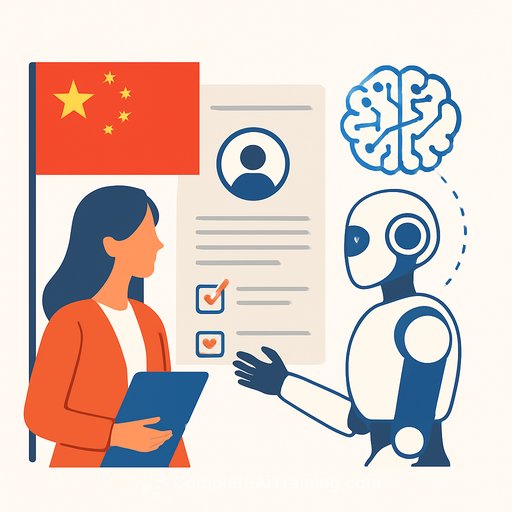
AI recruiters in China: faster, fairer hiring-and how HR can put them to work
AI is moving from pilot to standard across HR in China. State-owned China International Intellectech Group (CIIC) just launched a digital HR platform featuring an AI recruiter, Guangmou, that evaluates candidates and builds interview plans end to end.
Globally, 72% of HR professionals now use AI, up from 58% a year earlier. Trust is rising too, from 37% to 51%, with most respondents believing AI can reduce racial and gender bias.
What's changing on the ground
Beijing-based Zhaopin launched an AI interview assistant seven years ago. "AI can help human recruiters process vast amounts of data using unified standards and offer recommendations through multidimensional analysis to assist decision-making," says Li Qiang of Zhaopin.
Chinese employers increasingly treat AI as a digital HR staff member-posting roles, screening resumes, designing interview plans, even conducting interviews. A Nowcoder study reports 71.5% of companies used AI in hiring last year, a threefold jump.
Policy is pushing adoption
Public agencies are backing the shift. Zhang Wenmiao at the Ministry of Human Resources and Social Security noted that AI has "significantly improved the efficiency of talent mobility."
Cities are competing to lead. Shanghai recently asked HR agencies to adopt AI-powered recruitment for better job matching.
Why HR leaders should care
- Consistency with oversight: Standardized screening reduces noise and helps surface stronger shortlists without losing human judgment.
- Speed to hire: Automated sourcing, matching, and interview plan generation compress cycle times.
- Fairness by Design: When audited properly, AI can curb subjectivity that leads to bias.
- Scalable personalization: Interview flows can adjust to each candidate's profile and role.
- Operational visibility: Clear analytics on funnel health, recruiter load, and bottlenecks.
How to implement in 90 days
- Week 1-2: Define the target roles and success metrics. Pick 1-2 high-volume roles. Set goals for time-to-shortlist, quality-of-hire proxies, and candidate satisfaction.
- Week 2-4: Select the AI stack. Prioritize tools that handle sourcing, resume screening, and interview plan creation. Ask vendors for bias testing results, audit logs, data residency options, and ATS/HRIS integrations.
- Week 4-6: Build governance. Establish human-in-the-loop checkpoints, override rules, and escalation paths. Document decision criteria.
- Week 6-8: Fairness and compliance checks. Run adverse-impact analysis, validate assessments across groups, and set monitoring thresholds. Use a simple risk framework such as the NIST AI RMF to structure reviews.
- Week 6-9: Candidate experience. Disclose AI use, obtain consent where needed, and give clear feedback channels. Keep messaging human.
- Week 8-10: Data and security. Define retention windows, access controls, encryption, and vendor SLAs. Limit data to what's relevant to the role.
- Week 10-12: Train the team. Show recruiters how to prompt, review AI recommendations, and flag edge cases. Start with a controlled pilot, then expand.
Practical checkpoints before you scale
- Inputs: Are job descriptions and competencies clearly defined and current?
- Labels: Do you have ground truth for what "qualified" looks like in each role?
- Feedback loop: Can recruiters quickly correct AI decisions and feed that back into the system?
- Monitoring: Do dashboards flag drift in fairness, accuracy, or time-to-fill?
Metrics to track
- Time-to-shortlist and time-to-offer
- Qualified candidates per opening and interview-to-offer ratio
- First-90-day retention and hiring manager satisfaction
- Fairness indicators across demographics
- Recruiter hours saved and cost per hire
- Candidate satisfaction (CSAT/NPS)
What leading firms are doing right now
Companies are asking for configurable AI HR resources rather than one-size-fits-all products. According to Li Qiang, more employers want systems that can adjust workflows, reports, and interview plans by role or business line-without adding headcount.
CIIC's Guangmou points to where this is heading: AI that understands the job, the candidate, and the team-and assembles the right assessment steps automatically.
Risks to manage (and how)
- Bias drift: Schedule quarterly fairness audits; retrain with updated data.
- Over-automation: Keep humans in critical decisions and edge cases.
- Data privacy: Minimize data collected; enforce retention limits and access controls.
- Black-box models: Prefer tools with explanations, audit trails, and clear error handling.
- Regulatory changes: Assign an owner to track guidance from labor authorities and update policies.
The takeaway for HR
AI recruiters are no longer experimental in China. With public support, strong vendor options, and clear efficiency wins, the question is timing and controls-not if, but how.
Start small, measure hard, keep humans in the loop, and make fairness non-negotiable. That's how you ship better hiring now.
Upskill your team
If your HR function is building AI capability, here's a curated place to start: AI courses by job.
Your membership also unlocks: