
AI news ·
China bets on embodied AI to lead global robotics race despite software gaps and job displacement risks
China produced 90% of the world's humanoid robots in 2025, backed by $120 billion in state funding-but most still perform only narrow, scripted tasks. Western firms have a closing window to compete on capability before the cost gap disappears.
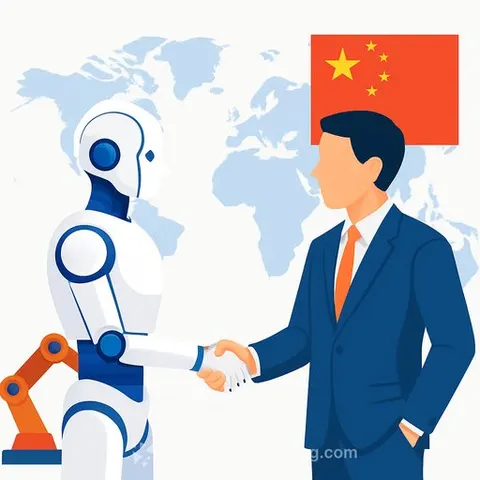
China's robotics push threatens to repeat EV dominance playbook
China produced 12,800 humanoid robots in 2025-about 90 percent of global output-but that number masks a harder reality: these machines remain far from ready for widespread factory deployment. Most still perform only narrow, scripted tasks. Yet the government is pouring $120 billion into the sector over the next two decades, betting that embodied AI-robots that perceive and act in the physical world-will solve labor shortages and drive economic growth.
For product development professionals, the implications are immediate. Chinese manufacturers are moving faster and cheaper than Western competitors. If history repeats the EV pattern, European and American firms face a narrowing window to compete.
Where China has the edge
China's industrial base gives it a structural advantage. The country installed more industrial robots over the last five years than all other countries combined. Chinese companies now supply over 57 percent of the domestic market, overtaking foreign competitors for the first time in 2024.
EV makers-already dominant in battery and sensor technology-are pivoting into robotics. XPeng uses autonomous-driving sensors for robot navigation. GAC's GoMate and Spirit AI's Xiaomo run on EV-derived batteries. This convergence matters: China controls 63 percent of the global supply chain for humanoid robot components, including actuators and rare earth materials.
Cost is the immediate competitive lever. Unitree's G1 humanoid costs around €11,650, compared to Boston Dynamics' Atlas at €120,000 or more. Chinese firms still need to cut costs by half to hit commercial viability thresholds, but they're moving in that direction faster than rivals.
The software problem
China's weakness is glaring: software. Nearly every major Chinese robotics company depends on Nvidia's AI chips and development tools. Nvidia's Jetson modules, foundation models, and Isaac simulation platform have become the industry standard.
This creates a vulnerability. As robots become more capable, US export controls could tighten. For now, Nvidia has positioned itself as the essential supplier-the same role it plays in generative AI.
Chinese teams are working on vision-language-action models that let robots interpret visual input and respond in real time. AgiBot announced its GO-1 model in 2025. Galbot is building narrower models for specific tasks like grasping or retail picking. But these remain far behind Nvidia's GR00T or Google DeepMind's Gemini Robotics in generalization and reliability.
The gap between demos and deployment
Corporate videos showing humanoids dancing or kickboxing are misleading. Most demonstrations rely on teleoperation or preprogramming, not autonomous decision-making. Robots in actual factory trials perform limited, repetitive tasks under controlled conditions.
UBTech's founder acknowledged that humanoids are "only half as efficient as humans" at real work. They struggle with multi-step coordination, fine manipulation, and hand-eye tasks like cable assembly. Midea's six-armed humanoid handles washing machine assembly. Kepler Robotics' K2 carries loads up to 30 kilograms. These are incremental improvements, not breakthroughs.
The training data problem is acute. Robots need multiple data types-images, language, touch, spatial information-which are scarce and difficult to standardize across different hardware platforms. Chinese firms are building dedicated facilities to generate training data, or using simulation with Nvidia tools.
What policymakers are betting on
Beijing has made embodied AI a national priority in its 15th Five-Year Plan through 2030. The "Robot+" initiative and "AI + Manufacturing" roadmap target doubling China's manufacturing robot density by 2030. The government is subsidizing up to 30 percent of automation project costs in some provinces and offering purchase discounts for humanoids.
A National Venture Capital Guidance Fund and three regional funds allocated 1 trillion yuan (€120 billion) over 20 years to back domestic robotics companies. The Ministry of Industry and Information Technology established a Standardization Committee for Humanoid Robots to set rules.
This is the same playbook that worked for EVs: state support, industrial capacity, cost discipline, and market scale. But the risks are different.
The employment problem China isn't solving
Estimates suggest robots could replace at least 70 percent of China's manufacturing jobs. The country has nearly 300 million migrant workers with precarious employment and minimal social safety nets. They're the most vulnerable to displacement.
Official messaging frames this as "empowerment" rather than substitution. Policy documents talk about human-machine collaboration and harmony. But Chinese experts are increasingly vocal about the risks. Studies conclude AI will displace jobs much faster than it creates them, straining wages and the social security system.
China's talent shortage is paradoxical: the AI industry needs 5 million workers while youth unemployment sits around 17 percent. The government is aware of the problem-recent policy documents explicitly call for assessing AI's employment impact. But Xi Jinping's administration has no intention of building a welfare state to cushion the transition.
What this means for product development
The robotics sector is in early stages, with around 150 Chinese companies competing on different technical approaches. Some focus on hardware components, others on software platforms. The field is unsettled, which creates both opportunity and risk.
For Western product teams, the immediate pressure is cost and speed. Chinese competitors are shipping cheaper, functional robots into real factories-even if they're not fully autonomous yet. The EV industry showed how quickly this gap can close.
European firms retain advantages in precision components and high-end industrial robots. Swiss-Swedish ABB and Japanese FANUC still dominate the premium segment. But that moat is narrowing. Chinese companies are actively working to replace imported ball screws, reducers, and sensors with domestic alternatives.
The software layer remains contested. AI for Product Development teams should track progress in vision-language-action models and world models-the emerging frontier for truly autonomous robots. This is where the next competitive advantage will be won or lost.
Standardization will matter. The MIIT's new committee could accelerate consolidation, weeding out weaker players and focusing capital on winners. Watch for which companies get early access to government testing centers and training data facilities.
The broader strategic question
China is betting that AI Agents & Automation can solve structural economic problems-aging population, shrinking workforce, need for manufacturing competitiveness. The government sees embodied AI diffusion as both a productivity tool and a path toward artificial general intelligence.
Whether this gamble pays off depends on three things: solving the software and precision challenges, reducing costs to commercial viability, and managing the social disruption. China is making progress on the first two. The third remains unsolved.
For product development teams in manufacturing, the message is clear: Chinese robotics firms are coming, with state backing and industrial scale. The window to compete on cost and speed is closing. The question is whether Western firms can compete on capability and precision before that gap closes too.