China prepares targeted AI employment policy: what HR needs to know
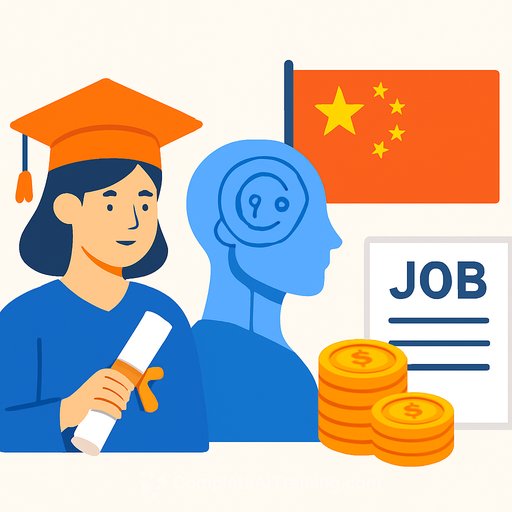
China is set to release a policy framework to manage AI's impact on jobs while pushing new employment growth, according to the Ministry of Human Resources and Social Security. The plan targets AI-related disruption, prioritises college graduates, and aligns with a wider strategy to stabilise the labour market.
Beyond AI, authorities aim to unify urban-rural employment systems and strengthen long-term safeguards so households don't slip back into poverty. For HR leaders, the message is clear: redesign roles, accelerate upskilling, and build stronger entry-level pipelines. See the AI Learning Path for VP of Human Resources for leadership-focused guidance on workforce planning and upskilling.
Key signals for HR
- Dedicated policy on AI's impact on employment, with support for affected industries.
- Graduate and youth employment set as a priority to absorb technology-driven shifts.
- Unification of urban-rural employment systems to improve mobility and access.
- Permanent support mechanisms focused on income stability and preventing a return to poverty.
What this means for your workforce plans
Expect more guidance and incentives for job creation and reskilling, especially for entry roles. HR teams should prepare to show how AI adoption protects employment while lifting productivity.
- Run an AI impact audit: map tasks at risk, tasks augmented by AI, and new roles created.
- Redesign roles around skills, not titles. Break jobs into tasks and rebuild with human-in-the-loop workflows.
- Prioritise graduate pipelines: internships, apprenticeships, and bootcamps tied to real projects.
- Bridge urban-rural talent: remote-first policies, regional hubs, and partnerships with local job centres.
- Deploy continuous upskilling: short, stackable training linked to internal mobility and pay progression.
- Set AI guardrails: documented job-impact assessments, bias checks, and clear worker communication.
Practical actions for the next 90 days
- Inventory top 20 roles by headcount. Score each on automation risk, augmentation potential, and reskill time.
- Publish a job redesign playbook for managers: task decomposition, AI usage rules, and escalation paths.
- Lock in graduate intake targets with defined rotations into data, operations, and AI-assisted roles.
- Stand up an internal mobility program: 6-8 week upskilling sprints tied to open requisitions.
- Pilot rural hiring for suitable roles; set up remote-ready onboarding and mentorship.
- Track leading indicators: redeployment rate, time-to-upskill, entry-level retention, and wage progression.
Why the urban-rural unification matters
Unified employment systems lower friction for talent movement and hiring. HR can tap larger talent pools, reduce vacancy times, and support regional equity goals with remote work and satellite offices.
Design roles with location flexibility where feasible. Pair this with standardized pay bands, skills-based assessments, and clear promotion criteria to avoid regional bias.
Graduate and youth employment: build a reliable funnel
With graduates in focus, companies that offer structured learning paths will have an edge. Move beyond generic internships.
- Create role-ready academies tied to live tools and datasets used by your teams.
- Assign mentors, define skill checkpoints, and convert top performers quickly.
- Publish transparent skill maps so candidates know how to progress within 12-18 months.
Long-term safeguards and HR's role
Permanent support mechanisms aim to stabilise incomes as technology reshapes demand. HR can reinforce this with predictable hours, fair scheduling, and pathways from temporary to permanent roles.
- Offer guaranteed minimum hours for transitional roles where possible.
- Partner with local employment services to match displaced workers to retraining and openings.
- Use skills-based hiring to open doors for first-time job seekers and rural candidates.
Resources
- China Ministry of Human Resources and Social Security
- Xinhua (official updates)
- ILO: Future of Work
- AI courses by job role (build team upskilling plans)
- AI automation certification (hands-on, project-focused)
The policy direction is clear: use AI to strengthen, not erode, employment. HR teams that get ahead on job redesign, graduate pipelines, and continuous upskilling will be ready when the framework lands.
Your membership also unlocks: