
AI news ·
Chinese product manager builds 6 AI agents and finds herself working longer hours, not fewer
A Chinese AI product manager built six specialized agents that now handle 60-70% of her daily work. Her hours didn't drop - she stays up until 2 a.m. taking on projects she couldn't before.
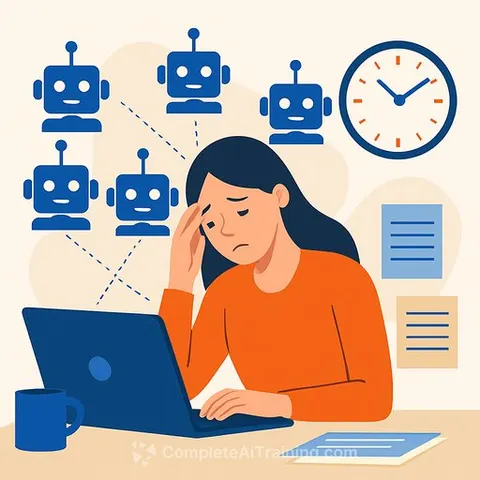
Product Manager Creates Six AI Agents. Now She Works Until 2 a.m.
Vivi Mengjie Xiao, an AI product manager in China, built six AI agents on OpenClaw to automate her repetitive work. Her output soared. So did her exhaustion.
Xiao said she now publishes daily podcast episodes, manages finances in real time, and creates content across multiple platforms - all while working full-time. She handles 60 to 70 percent of her daily operational work through AI agents. But her workday hasn't shortened. Instead, she stays up until 2 a.m. tackling new projects her freed-up capacity now allows.
"When your efficiency goes up, you don't work less," Xiao said. "You just attempt more."
How She Built Her AI Team
Xiao started by trying to cram all tasks into a single AI agent. The agent became overwhelmed and unfocused, jumping between tasks without helping her concentrate. She split the workload across six specialized agents instead.
Three agents handle work: an administrative assistant, a researcher, and a chief of staff that mimics her boss's communication style for presentation practice. Three agents manage personal life: a life coach, a content assistant, and a finance assistant.
The agents connect to each other. Her life coach agent reads conversations from all five others, allowing it to provide context-aware journaling. Xiao said 70 percent of her daily journaling is now automated.
Xiao used to spend four hours daily gathering AI industry news from X, newsletters, and blog posts, then translating English sources into Chinese for her 45,000 RedNote followers. The agents eliminated that work entirely.
The Productivity Paradox
Xiao described a counterintuitive pattern: efficiency gains don't reduce work hours. They enable more ambitious work.
She shifted from administrative tasks to creative and strategic work - the higher-leverage activities she couldn't reach before. But the capacity freed up by automation didn't translate to downtime. It translated to new projects.
"It felt like building a real team," Xiao said. "You don't hire six people on day one. You start with one, and as the workload grows, you specialize."
What This Means for Product Teams
Xiao sees a structural change in how work gets organized. The Industrial Revolution standardized physical labor. The information revolution standardized knowledge work. AI is now standardizing execution work - the operational "how" of getting things done.
That shift changes what companies need. The premium moves from execution ability to three capabilities: taste and judgment, ability to direct AI, and emotional intelligence.
The question for companies becomes practical: do you need 10 junior analysts, or one senior thinker with 10 AI agents?
Xiao calls this future model the "one-person studio" - solo creators and operators using AI to produce at team-level scale. She said the approach isn't about replacing humans. It's about freeing humans from repetitive execution to focus on judgment, creativity, and connection.
AI Agents & Automation are reshaping how product managers approach their work. Understanding how to build and manage these systems has become a core competency. For product managers exploring how AI can drive innovation beyond cost-cutting, Xiao's experience offers a practical case study in what's possible - and what the tradeoffs actually are.