
AI news ·
College graduates jeer AI advocates at commencements as universities face pressure to adapt
Curricula lag market needs by two to three years, urging universities to blend AI literacy with critical human skills.
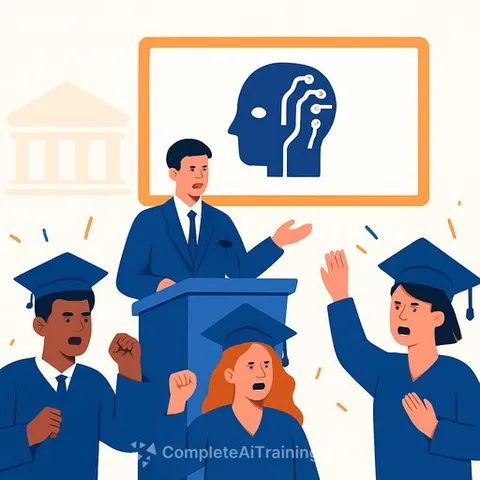
At graduation ceremonies this June, some U.S. college graduates jeered at commencement speakers who praised artificial intelligence, a signal of the unease many students feel about their prospects in an AI-altered job market. Former Google CEO Eric Schmidt faced such a backlash at the University of Arizona, while incoming freshmen worldwide question whether their degrees will still have value. The tension highlights a widening gap: employers demand AI literacy, adaptability, and human judgment, but university curricula often lag by years.
Bernard Ghanem, Professor and Chair of the Center of Excellence for Generative AI at KAUST, said universities can no longer limit themselves to delivering knowledge. "This specifically includes AI literacy, lifelong learning, real-world innovation, and adaptability," he said. "Universities or other educational institutions that quickly make this pivot will reap short- and longer-term benefits."
Curricula lag the job market
Despite the urgency, many colleges in the region are slow to adapt. Nirmal S. Chhabria, Academic Director of the EMBA at Georgetown Dubai, said most curricula lag market realities by two to three years. "True redesign requires dismantling siloed departments and embracing continuous curriculum evolution," Chhabria said. "The future belongs to schools willing to blur classroom and boardroom boundaries, where students solve actual business challenges rather than just focusing on theoretical ones."
Ghanem said that while there is no clear reference standard for redesigning education around AI, many institutions in Saudi Arabia and the UAE are developing AI-first strategies. For example, KAUST and others are offering AI-specific degrees, mandating AI literacy, and building industry partnerships that embed real-world projects into coursework. These efforts are part of a broader movement to integrate AI literacy into teaching practice-an area where resources such as AI for Education courses help educators build the necessary skills.
The premium on human skills
AI expertise alone is not enough, university and industry leaders cautioned. Dino Varkey, CEO of GEMS Education, said that as AI becomes better at processing information, "the qualities that make us human become more valuable-creativity, empathy, communication, ethical judgment, leadership, and collaboration." He stressed that the most successful individuals will be those "who can harness AI effectively while applying uniquely human insight, values, and decision-making."
Chhabria, who hires for private equity, startups, and academia, said technical AI skills can become outdated in 12 to 18 months, while judgment, persuasion, and adaptability gain value over time. "AI handles computation; humans navigate ambiguity, stakeholder complexity, and ethical trade-offs," he said. "The workers who'll thrive aren't just going to be AI specialists-they're thoughtful generalists who understand business, psychology, and systems thinking alongside technology."
Prof. Nathalie Martial-Braz, Vice-Chancellor of Sorbonne University Abu Dhabi, said critical thinking remains universities' fundamental mission, but it must be directed. "If we teach only knowledge, we lose the battle; if we teach how to think, students master adaptation, create tomorrow's innovations, and remain vigilant against the biases of innovation," she said. "Soft skills aren't nostalgic luxuries; they are operative necessities."
Competency tracking and real-world assessments
Traditional transcripts are losing their signaling power. Employers increasingly want evidence of what a candidate can do, not just what they know. Martial-Braz said Sorbonne University Abu Dhabi is exploring hybrid models that pair structured evidence of real achievements with documentation of the learning process. "Meaningful competency tracking requires transparency about learning pathways, not just outputs," she said. "Employers need both what students can do and how they learned to do it."
Ghanem added that with many candidates sharing similar technical backgrounds, students must demonstrate capabilities that set them apart-practical experience gained through project-based work, hackathons, and industry-aligned coursework. Universities, he said, need to continuously engage with industrial partners to adapt course content quickly, a process that demands ongoing communication between faculty and employers.
Redesign that keeps pace with the market
The shift requires more than adding elective courses. Experts called for a deep, agile redesign of learning objectives, teaching methods, and assessment. Ghanem said the process must be fast and coordinated: "The timeliness of this process requires all stakeholders-universities as well as the public and private sectors-to be involved and nationwide coordination to be ensured for optimal and quick outcomes."
Varkey argued that the future will reward adaptability over credentials alone. "Schools and universities need to move beyond knowledge transfer and focus on developing problem-solvers, innovators, entrepreneurs, and lifelong learners," he said. In an AI-driven economy, those who can continuously learn, unlearn, and reinvent themselves will have the edge.
Why this matters for education professionals
For faculty, administrators, and instructional designers, the message is clear: incremental adjustments won't cut it. The pressure is to dismantle department silos, tie learning outcomes to real-world competencies, and build feedback loops with industry that update curricula in months, not years. Programs that blend AI literacy with durable human skills-and give students a verifiable record of what they can actually do-will become the new benchmark. Those that delay risk producing graduates who are technically trained but unable to navigate the ambiguity, ethical trade-offs, and constant change that define the modern workplace.