
AI news ·
Communities across the US push back against data center expansion amid job loss and environmental concerns
Nearly half of planned 2026 U.S. data centers face delays or cancellation due to community pushback. Residents cite minimal permanent jobs, heavy water and power use, and pollution concentrated in low-income and Black neighborhoods.
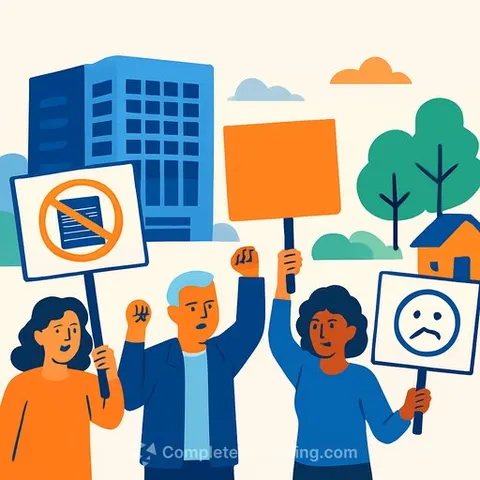
Data Center Boom Creates Jobs Promise, Delivers Environmental Cost
Tech companies are pushing data center development across the U.S. at an accelerating pace, targeting rural farmland and abandoned industrial sites in low-income communities. Developers promise job creation and tax revenue. The reality, according to residents and environmental advocates fighting these projects, is different: minimal permanent employment, heavy resource consumption, and pollution concentrated in Black and brown neighborhoods.
Nearly half of all planned data centers in 2026 face delays or cancellation due to local opposition, Bloomberg reported. Communities from Port Washington, Wisconsin to Landover, Maryland are organizing against projects they say prioritize corporate profit over public health.
The Job Creation Claim
Developers from Vantage, QTS (owned by Blackstone), and CoreWeave tell communities their projects will create thousands of jobs and generate property tax revenue. Construction work is temporary. Once operational, data centers run with skeleton crews-meaning few permanent positions materialize.
Tech layoffs tell another story. Companies cut 45,000 jobs in March alone while simultaneously investing billions in data center infrastructure and AI. The capital freed from workforce reductions funds new facility construction.
Water and Power Demands
Data centers consume enormous amounts of electricity and water. Two hyperscale facilities planned for Wisconsin will use more energy than every household in the state combined, according to local estimates. About 60% of U.S. electricity comes from fossil fuels-natural gas, coal, and oil.
Water usage creates a second strain. Facilities require reliable cooling water sources, making farmland adjacent to lakes and rivers prime targets. Port Washington sits on Lake Michigan's shoreline. The OpenAI and Oracle joint facility planned there will occupy 1,200 acres and dump treated glycol-solution water into the lake, which supplies Wisconsin's drinking water.
Pollution Concentrated in Specific Communities
Developers often target low-income and Black neighborhoods for data center siting. These communities already face disproportionate air and water pollution from existing industrial operations.
Memphis's historically Black south side hosts xAI's "Colossus I and II" data centers. The facilities operate 27 unpermitted natural gas turbines continuously, producing smog and emitting formaldehyde and other chemicals. Long-term exposure causes asthma, certain cancers, and heart disease, according to health data.
Southaven, Mississippi faces a similar situation. Forty turbines there power data centers across state lines, with the NAACP and environmental legal organizations threatening Clean Air Act violations lawsuits against Elon Musk's xAI.
In Prince George's County, Maryland, a proposed data center on an abandoned mall site in Landover has sparked a petition with nearly 24,000 signatures. The facility's end user remains anonymous.
Community Resistance Growing
Port Washington residents secured a major win. A petition requiring public referendums on tax incentives for major developments collected 1,000 signatures in one week and passed by a nearly 2-to-1 voter margin.
Taylor Frazier McCollum, organizing against the Landover project, said: "The people of Landover are fighting a proposed hyperscale data center with an unknown end user. It doesn't matter who plans to use it, we will fight the pollution and disruption of our community until the end. We have a temporary moratorium, but we are pushing for a permanent ban."
Town councils across the country are fielding petitions and hosting contentious public meetings. The scale of opposition has delayed or cancelled nearly half of planned 2026 data center projects.
What Construction and Real Estate Professionals Should Know
For those working in construction and real estate development, data center projects represent significant revenue opportunities-but also increasing community friction that can derail deals. Understanding local opposition dynamics is essential for project viability.
Communities are demanding transparency on end users, environmental impact assessments, and binding community benefit agreements. Some municipalities are implementing moratoriums or stricter permitting requirements. Politicians face pressure from both developers and residents, creating unpredictable approval timelines.
The trend suggests that future data center projects will require more extensive community engagement earlier in planning stages. Developers who ignore local concerns face petition drives, legal challenges, and political obstacles that can extend timelines or kill projects entirely.
For more on how AI is changing real estate and construction work, see AI for Real Estate & Construction.