
AI news ·
Companies that cut jobs for AI are rehiring laid-off workers as technology falls short
Klarna fired 2,100 workers to save money on AI, then rehired them after complaints spiked. A 2025 survey found 68% of companies that cut staff for AI had already brought some workers back.
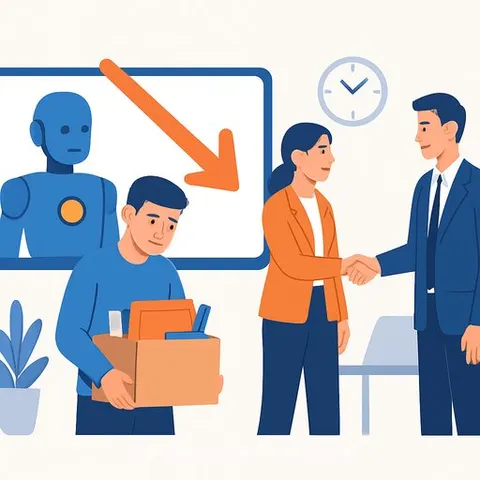
Companies Are Rehiring Workers They Laid Off for AI. Here's Why.
Klarna cut its workforce by 2,100 employees last year, betting that artificial intelligence could handle customer service tasks. The Swedish fintech company saved $10 million. It also lost customers. Complaints spiked and satisfaction plummeted. By the second half of the year, Klarna began rehiring the workers it had fired.
Klarna was not alone. A February survey by Careerminds, an HR consulting firm, found that 68.3% of companies that restructured workforces due to AI in 2025 had already rehired some laid-off employees. More than a third rehired more than half of them.
This pattern-layoff, then rehire-reflects a widening gap between what companies expected AI to do and what it actually does.
AI Didn't Perform as Promised
In the Careerminds survey, 55% of HR professionals said AI required more human judgment than they anticipated. Another 35% reported losing critical skills and expertise when they cut staff. Twenty-eight percent found their remaining employees lacked the skills to fill the gaps.
Real-world failures reinforced the lesson. McDonald's tested an AI ordering system at 100 drive-thru locations and pulled it after the system added excessive butter to ice cream orders and hundreds of dollars worth of unwanted chicken nuggets. Prosus, a Dutch investment firm, developed an AI agent to replace data analysts but abandoned the project because minor errors frustrated customers.
Verizon planned to replace call center staff with AI but announced this year it would hire more human representatives instead. A company source said 40% of consumers still prefer speaking to a person and express frustration when they cannot reach one.
The financial cost of these missteps proved steep. Forrester Research found that companies paid 1.27 times the cost of their layoffs in lost productivity and knowledge gaps while trying to save money with AI.
Regret Sets In
When asked what they would do differently, 91.6% of companies that conducted layoffs said they would change course. Forty-one percent said they would pursue alternative measures instead of cutting staff. Half said they would reduce the number of layoffs.
An Orgvue survey of executives who reduced workforces to replace them with AI found that 55% admitted their layoff decisions were wrong. The firm noted that companies rushed to cut staff without fully understanding AI's limits.
Gartner predicts that by 2027, 50% of companies that reduced workforces due to AI will rehire employees. Kathy Ross, a Gartner senior analyst, said: "While AI-driven layoffs have garnered attention, the reality is far more complex. As companies confront AI's limitations and rising customer expectations, reinvesting in talent will be necessary to maintain service quality and growth."
Hiring Is Expanding Again
Some companies are going beyond rehiring. IBM announced in March it would triple new graduate hiring in the U.S. this year across software, consulting, infrastructure, and marketing roles.
Nickle LaMoreaux, IBM's Chief Human Resources Officer, said: "If we do not sustain investment in new hires, the talent supply chain will collapse and the talent pool will deplete in 3-5 years. Companies must redefine roles for the AI era."
A Teneo survey of 350 global CEOs found that 67% are increasing hiring across all levels this year due to AI adoption. The top reasons: strengthening workforces alongside AI and automation (50%) and upskilling talent (46%).
This hiring surge is not a return to pre-AI expansion. Companies are rehiring to reinforce areas AI cannot fully replace and to address skills gaps during the transition.
Experts view the current hiring increase as temporary. The International Monetary Fund projects that AI will affect approximately 40% of global employment and 60% of jobs in advanced economies.
For HR leaders, the lesson is clear: understanding AI's actual capabilities and limitations before making workforce decisions matters more than speed. Companies that rushed implementation are now paying the cost of rehiring, retraining, and rebuilding culture.