
AI news ·
Contact center workforce strategy needs a redesign as AI shifts routine work away from human agents
AI won't eliminate contact center jobs, but it will strip out routine work and leave agents handling harder, more emotional interactions faster than most teams can adapt. Workforce planning, training, and scheduling all need to change to keep up.
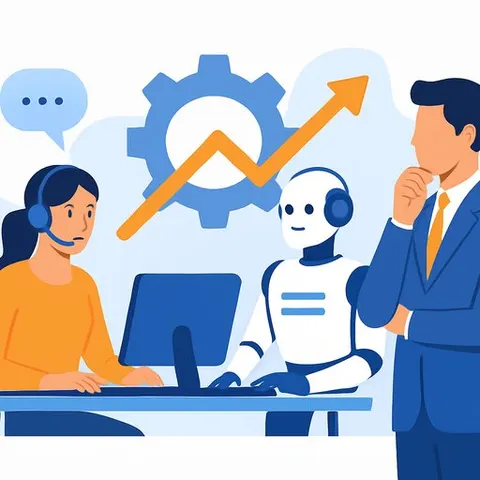
Your Contact Center Workforce Strategy Is About to Break Under AI Pressure
AI isn't going to eliminate human contact center jobs. Gartner says none of the Fortune 500 are expected to fully eliminate human customer service by 2028. But what's coming is something harder: the work itself is changing faster than most contact centers can adapt.
More than 80% of organizations plan to expand human agent responsibilities as AI spreads. At the same time, 68% of support interactions with tech vendors could be handled by AI by 2028. The gap between what AI can do and what customers still want from humans is where the real workforce problem lives.
The issue isn't deployment. It's that contact centers are still planning for steady work volume, predictable patterns, and automation as a side layer. That model breaks the moment AI starts handling routine contacts.
How AI Changes the Work Agents Actually Do
AI doesn't replace agents. It strips out the easy work first: status checks, password resets, account updates, simple troubleshooting. McKinsey says 50-60% of interactions still sit in that transactional bucket.
What lands with people after that is the hard stuff. Confused customers. Exceptions. Policy disputes. Conversations that already went sideways in self-service. Loyalty-risk moments.
That means the job gets narrower in scope but steeper in skill demand. Agents no longer need faster keyboard skills. They need better judgment, better recovery skills, more empathy, and usually more time to prevent issues from compounding.
Why Traditional Workforce Planning Models Are Breaking
Most contact centers forecast labor as if work arrives in a steady stream. AI ruins that pattern.
Once automation takes routine contacts, the human queue stops looking normal. What's left is slower, messier, more emotional, and more likely to spike when the system gets confused. One weak model update, one intent-classification problem, and suddenly your "saved volume" comes rushing back as escalations.
The planning problems most teams weren't built for:
- Volume drops, but difficulty rises
- Fewer contacts hit agents, but each one takes more judgment
- Escalation waves matter more than average demand
- Staffing gaps show up in specialist queues first
- Recovery time starts to matter almost as much as occupancy
This is why workforce planning for AI contact centers feels off even when containment looks good on paper. The old model rewards neat averages. Real service doesn't behave that way anymore.
Reclassify Work Into Three Categories
The first mistake is treating all service work as if it sits on one spectrum. It doesn't.
Leaders need three separate buckets:
- Automate: simple, repetitive, low-risk work
- Augment: work where AI can assist, guide, summarize, or route
- Human-owned: high-emotion, high-risk, policy-heavy, exception-heavy work
Drafting something, recommending something, and actually carrying it out are three different moves. They need three different levels of control.
Treat AI As Capacity, Not As a Feature
Most teams still plan as if AI is just software sitting beside the workforce. Really, AI is part of the operating capacity.
AI has throughput limits, confidence thresholds, retry behavior, and failure patterns. It changes queue behavior, handoff timing, and what "coverage" means. Gartner's January 2026 forecast says GenAI cost per resolution could exceed $3 by 2030, which means AI capacity has to be measured and managed, not treated as "free efficiency."
Track the things old staffing models ignored:
- Where confidence drops
- How often customers retry before escalation
- Which intents fail after updates
- How AI latency or drift affects handoff volume
- Where specialist human coverage is actually needed
Redesign Roles and Career Paths Around Harder Work
Once AI removes the easy calls, the frontline job changes fast. The old "start with simple contacts, build confidence, move up later" ladder gets thinner.
Agents are moving toward oversight, judgment, and higher-value problem-solving. Supervisors, planners, and quality teams also take on more analytical and coaching-heavy work. Gartner says 84% of organizations expect to add new skills to the agent role, and 58% plan to move agents toward knowledge-management specialist work.
Design for roles like:
- Escalation specialist
- Journey recovery specialist
- Knowledge-management specialist
- AI-aware supervisor
- Planner focused on blended human and AI capacity
You're hiring judgment-heavy operators now, not script readers.
What Skills Matter Most for Agents
Companies often say agents need "AI literacy" and leave it at that. That's not enough. Sure, people need to know how to use the tools. What really carries AI-augmented teams is still human skill. The stuff machines still stumble over.
Focus on:
- De-escalation
- Critical thinking
- Policy judgment
- Context synthesis
- Trust repair after failed automation
- AI discernment: when to trust it, when to challenge it, when to override it
The job gets narrower in task range, but steeper in skill demand.
Redesign Training Programs
When the skills and role change, the training needs to change too. One-hour walkthroughs of new tools don't do much.
AI removes the easy practice reps. Newer agents get pushed toward harder interactions sooner, often with incomplete AI context in front of them. They need more actionable development strategies.
Build training that covers:
- Tool fluency
- Simulation for difficult interactions
- Override judgment
- Handoff handling
- Manager coaching for AI-influenced calls
- Refreshers after workflow or policy changes
Real-time support helps too. AI-led agent coaching can give employees prompts in the flow of work so they're not forced to search for guidance mid-task.
Reshape Scheduling for Blended Journeys
Shared queues distributed between human and AI agents don't behave like old human-only environments. AI failures cluster. Escalations come in waves. Customers arrive later in the journey and are more irritated.
39% of virtual-agent interactions still reach live agents. 80% of contact center leaders said headcount stayed flat or rose in 2025. 73% said after-call work stayed the same or increased. Those numbers kill the fantasy that AI drains volume out of the system.
Blended scheduling needs room for:
- Escalation buffers
- Specialist coverage
- Oversight windows
- Recovery time after dense emotional work
- Fast response when containment swings unexpectedly
Run Change Management Like It Matters
If agents hear "AI" and assume it's really a headcount conversation in disguise, the rollout is already off to a bad start. 32% of leaders say agent distrust in AI is a problem. 59% admit they aren't giving teams ongoing coaching and support for AI-driven workflows.
Be direct about three things:
- What AI is changing
- What still belongs to humans
- How success will be judged
Otherwise, agents fill in the blanks themselves. Not in a good way.
Put Human Checkpoints Where the Risk Lives
If AI can affect money, identity, access, eligibility, or anything regulated, a human checkpoint has to be built in. That's where oversight should sit. Not across every single task. Not missing entirely. Right where a mistake can do real damage.
The smartest setup is simple:
- AI can draft freely
- AI can recommend with controls
- AI should not commit high-risk actions without human approval
That model protects the customer, protects the brand, and honestly protects the agent too.
Measure the Right Metrics
You can't prepare agents for AI augmentation and still measure performance entirely on how fast they handle calls. Everyone can be fast with AI in the mix.
Look at:
- Resolution after AI-first journeys
- Repeat contact within a short window
- Successful handoff rate from AI to human
- Context retention during escalation
- Agent override rate on AI suggestions
- Exception volume by intent or workflow
- After-call work time
- Coaching needs by team or queue
- Attrition risk and burnout signals in high-complexity work
Surface productivity means very little these days. Look at the operational signals underneath. If one workflow has great containment but a spike in repeat contacts, that isn't a win. If handle time drops but specialist escalations climb, that isn't a win either.
How AI and Humans Work Together in Real Contact Centers
The best version of this isn't "AI handles tier one, humans take the rest." Real contact centers are heading toward shared workflows, where AI and people touch the same journey at different moments for different reasons.
That's why handoffs matter so much. A good handoff means AI collects the context, checks the simple stuff, takes care of routine actions, and hands everything over once the conversation gets tense, complex, or high-stakes. A bad handoff dumps the customer back at square one.
Strong AI-augmented teams need:
- Shared customer context across AI and human channels
- Routing that recognizes risk, sentiment, and complexity
- Clear rules for when AI stops and a person steps in
- Live assist tools that help without steering agents into lazy decisions
- Post-contact automation that cuts admin without hiding what happened
You also need orchestration for human and AI agents. One system rarely does the whole job. One tool may classify intent, another may retrieve policy, another may summarize, another may trigger workflow actions. If those systems aren't coordinated, and the parts where humans are involved aren't added in, the experience feels patchy and fast.
What's Next
AI doesn't ask whether you want to change the workforce. It just does it.
Once routine contacts shift into automation, the human job gets heavier. Planning gets trickier. Coaching gets more important. Bad handoffs get more expensive. Weak training shows up faster.
A serious contact center workforce strategy has to start with the people side. The tools matter. The harder question is whether the operation is actually preparing people for the work that remains.
The companies that survive won't just automate aggressively. They'll know how to build AI-augmented teams that don't destroy the human side of service.
Learn more about AI for Customer Support or explore the AI Learning Path for Call Center Supervisors to understand how to lead this transition in your organization.
FAQs
Will AI reduce contact center headcount?
Not in the clean, linear way vendors imply. Gartner expects companies to keep expanding human responsibilities even as AI spreads. What changes first is the work mix. Routine volume drops. Complex, emotional, and policy-heavy contacts rise. That shifts hiring, skills, and staffing models inside the contact center.
What does a blended workforce model look like?
It looks like shared ownership of the same customer journey. AI handles routine steps, gathers context, suggests next actions, and removes admin. Humans step in for exceptions, emotional recovery, judgment calls, and high-risk actions.
Why is average handle time becoming less useful?
Because the remaining human contacts aren't average anymore. Once AI strips out simple interactions, handle time gets distorted by denser, more emotional, and more complex cases. A longer call might mean the agent prevented churn, fixed a failed automated journey, or handled a policy exception correctly.
What skills matter most for agents in AI-augmented environments?
The big ones are judgment, de-escalation, policy interpretation, context synthesis, and knowing when to challenge the machine. Those are the skills that rise in value when easy work disappears. AI fluency matters too, but mostly in service of better judgment, not blind trust.
How should leaders measure AI and human performance together?
Measure the whole journey, not just isolated outputs. Track repeat contact after AI-first interactions, handoff quality, context retention, override rates, exception volume, after-call work, and burnout risk in complex queues. That's a much better read on whether AI-augmented teams are actually working than a simple containment number or lower average handle time.