
AI news ·
Customer frustration with AI stems from poor service and unresolved problems
Unresolved AI issues, not the technology, frustrate buyers and risk $1.9 trillion in U.S. spending. Firms must prioritize solving problems over deflecting tickets.
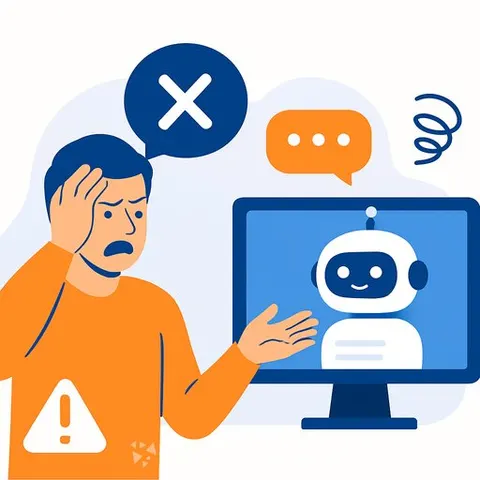
Customer frustration with AI in customer service is spiking, but the backlash is not about artificial intelligence-it's about unresolved problems and repeated friction, according to new survey data and a veteran support leader who has managed automation at some of the world's largest companies.
AnswerConnect tracking research across the US, UK, and Canada found that preference for a real person climbed while preference for AI fell sharply, with rising frustration levels. Yet the same data shows roughly four in five customers find AI helpful for simple, repetitive questions, and most will start with a chatbot if they can reach a person when needed.
Friction, not AI, drives the backlash
What frustrates customers is not the technology itself, but the friction it often creates. Glance's 2026 CX Trends research reported more loops and more time re-explaining issues as companies rushed to automate. Sixty-eight percent of customers said a complete resolution mattered most, ahead of speed, and only seven percent rarely had to repeat themselves across channels.
"They do not hate AI. They hate not getting their problem solved. They hate repeating themselves. They hate hitting a wall with no door," said an executive who previously led Device, Digital, and Alexa support for more than 200 million subscribers, with earlier roles at Visa, Capital One, and USAA. "When automation causes those things, customers revolt."
For support leaders, understanding how to integrate AI without frustrating customers is critical-resources like the AI for Customer Support topic page cover automation and chatbot strategies.
The deflection trap
The most expensive mistake in deploying service automation is optimizing for deflection instead of resolution. Deflection rate-sometimes called containment rate-measures how many contacts a bot handles without passing them to a human. It looks good on a balance sheet but can be gamed by making it hard for customers to escape or by closing sessions that never resolved the issue.
When teams stop rewarding containment and start rewarding resolution and low customer effort, two things happen: the automation gets better, and human associates handle only the complex, emotional cases where judgment and empathy create value. The handoff is where most of the damage happens. Customers don't object to starting with automation; they object to reaching a live agent and being told to start over.
"Fixing that one seam, so the associate opens already knowing what the customer tried and why it failed, lifted our scores more than any single piece of automation," the executive said.
What high-stakes industries reveal
In payments and banking, where a declined card or frozen account brings high emotion and fragile trust, the tolerance for a loop is zero. Customers never complained that an algorithm helped them-they complained when the system couldn't explain why their card was declined, or when authentication kept them spinning. The AI they welcomed was invisible: routing to the right associate, fraud models that caught problems early, and account history surfaced so no one had to ask twice.
"AI that informs and accelerates a person earns trust, and AI that blocks a person destroys it," the executive said. This principle travels across every industry: well over half of consumers say their trust would fall if a business relied mainly on AI.
Three principles for earning trust
For leadership teams deploying AI in customer service, three principles stand out:
- Measure resolution, not deflection. If your automation cannot point to problems solved, you're buying a quieter queue, not a better experience.
- Keep the door open and obvious to a person. Companies generating backlash are the ones hiding the exit. Customers will use automation first when they trust they can reach a human the moment they need.
- Never make the customer carry the context. Pass it. The handoff from machine to associate, and from one channel to the next, is where loyalty is won or lost.
Implementing these principles often requires upskilling teams. An AI Learning Path for Call Center Supervisors provides structured training on chatbot management and workforce optimization for support leaders moving from containment to resolution.
Why this matters for customer support
The cost of getting this wrong is enormous. Qualtrics and ServiceNow put $1.9 trillion in U.S. consumer spending at risk from poor experiences, with roughly four in five customers reporting they switched brands after a bad one. Customers are unforgiving of bad service and generous toward good service-regardless of who or what delivers it.
The so-called AI backlash is not a referendum on the technology. It's the same verdict customers have delivered for decades: they judge companies on whether their problem was solved and whether they were treated like a person. For customer support leaders, the winners in the coming years will be those who use AI to make service feel effortless and human, starting with handoffs that eliminate repetition and a relentless focus on resolution over deflection.