
AI news ·
Deepfakes challenge evidence authenticity in international arbitration
Zero proven deepfake cases exist in international arbitration, but tribunals face authenticity disputes. Existing evidence rules lack specific frameworks for AI media.
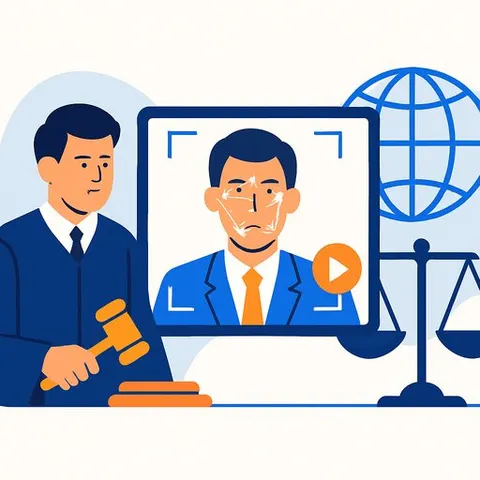
International arbitration faces a new evidentiary threat as artificial intelligence makes it easier to fabricate convincing audio, video, and images. Deepfakes-AI-generated or manipulated media-have not yet appeared in a publicly reported arbitration case as proven false evidence, but tribunals are already dealing with disputes over authenticity that could become far more difficult to resolve.
Deepfakes as an Evidentiary and Procedural Risk
Deepfakes are audiovisual content generated or manipulated through AI to alter a person's appearance, voice, statements, or conduct, or to distort the representation of an event. There is no known international arbitration case where a party has submitted a proven deepfake video. The absence of such a case does not make the problem theoretical. Arbitral tribunals have already confronted disputes over the authenticity, admissibility, and reliability of recordings and other contested evidence. Deepfakes intensify an existing problem rather than creating a new one.
In EDF (Services) Limited v. Republic of Romania (2009), the tribunal declined to admit an audio tape and transcript because their authenticity had not been established. Libananco Holdings Co. Limited v. Republic of Turkey (2008) showed that tribunals may adopt procedural safeguards when the integrity of the arbitral process is threatened. The claimant alleged that privileged and confidential communications had been intercepted, and the tribunal treated those allegations as engaging fundamental principles of procedural fairness, confidentiality, and the right to present a case without interference. A 2023 decision by the Higher Regional Court of Cologne considered whether a tribunal's reliance on a unilateral notarial video inspection of a production line, without adequate technical assessment, violated the respondent's right to be heard.
Audiovisual evidence often raises questions of authenticity, lawful collection, and technical assessment. Deepfakes make each of these questions more difficult. Manipulation becomes easier, detection harder, and objections to authenticity more likely.
Challenging genuine evidence poses a serious danger to what Charlie Morgan and Michelle Penelope King describe as "evidentiary integrity." As confidence in audiovisual evidence decreases, parties may argue that authentic but unfavorable material has been altered by AI. This phenomenon has been called a "Liar's Dividend" or the "Deepfake Defence." In arbitration, this risk has a specific procedural dimension. Tribunals often take a flexible approach to admissibility, leaving questions of reliability and probative value to be assessed later. There is an initial presumption of authenticity, and the burden of proof rests on the party relying on the evidence. But a flexible approach may become harder to maintain when deepfakes are involved. If tribunals admit audiovisual evidence too readily, they risk relying on manipulated material. If they require expert verification whenever AI manipulation is alleged, parties may use authenticity objections to delay proceedings, increase costs, or exclude harmful evidence at the admissibility stage.
Sejin Kim said that "deepfakes have greatly weakened the traditional assumption that what appears on screen is authentic." Tribunals need a middle ground. They should not treat audiovisual evidence as automatically reliable, but they should also be cautious about accepting unsupported allegations of AI manipulation.
Existing Rules and Their Limits
International arbitration has developed tools to assist tribunals on evidentiary matters, such as the IBA Rules on the Taking of Evidence in International Arbitration. However, the IBA Rules are not strictly mandatory. They are designed to be adopted "in whole or in part," in conjunction with the applicable procedural law and the circumstances of the case. This flexibility is a strength, but it may create uncertainty when tribunals face new technological risks like deepfakes.
The IBA Rules assume that parties and legal representatives will act in "good faith." That assumption is central to the fairness of the arbitral process. Yet deepfakes may make it impossible for tribunals to determine immediately whether a party has submitted fabricated evidence or whether an opposing party has raised an authenticity objection in good faith. Article 9(1) gives tribunals authority to decide on the "admissibility, relevance, materiality and weight" of evidence. The rules do not expressly identify AI-manipulated evidence as a separate ground for exclusion. In some circumstances, deepfake evidence may be addressed through existing categories, such as evidence "obtained illegally." But the absence of an express reference to AI manipulation suggests that existing evidentiary rules have not fully adapted to the specific risks posed by synthetic media.
A similar gap appears in the Chartered Institute of Arbitrators' Framework Guideline on the Use of Technology in International Arbitration, which regulates certain technological uses, including virtual reality for hearings, but does not provide a dedicated framework for deepfakes.
Hany Farid warned in The New York Times that "the unprecedented development of deepfake technology may be outpacing society's ability to detect and respond to it." Deepfakes also raise concerns beyond procedural admissibility. Because they may reproduce a person's image or voice, they may interfere with personality rights. Chinese courts have already considered the unauthorised reproduction of a person's voice in AI-generated content cases.
Article 1(4) of the IBA Rules confirms the decisive role that tribunals play: they can interpret the rules when a conflict arises regarding their meaning. The tribunal's role extends beyond admitting or excluding evidence; it includes preserving the fairness and integrity of the proceedings. For legal professionals who need to understand these emerging risks, AI for Legal Professionals Courses provide training on AI's impact on evidence and procedure.
Procedural Safeguards and Concrete Challenges
Technical tools and procedural measures such as hash verification, digital watermarking, chain-of-custody protocols, and pre-hearing evidentiary reviews can help establish the provenance and integrity of audiovisual evidence. They cannot always prove that the underlying content is genuine, but they make it harder to introduce undetected fakes.
The central procedural difficulty is to distinguish genuine authenticity concerns from tactical objections. A party challenging audiovisual evidence should be required to identify concrete reasons based on definite indicators: inconsistencies in metadata, unexplained editing, irregularities in the chain of custody, or other technical anomalies. Without such a requirement, deepfake objections risk becoming a tool for delay or exclusion rather than a legitimate safeguard.
Why this matters for legal professionals
Arbitrators and counsel cannot rely on traditional assumptions about the authenticity of audiovisual evidence. They must develop a framework that balances the flexible admissibility typical of international arbitration with rigorous authentication protocols. The key is to require specific, technically grounded challenges before shifting the burden of proof, while using available verification tools to protect the integrity of the record. As deepfakes become more sophisticated, the ability to manage these disputes will be a core skill for anyone handling international disputes.