
AI news ·
Digital twins become essential tools for planning gigawatt-scale AI data centers
AI data center investment is projected to hit $7 trillion by 2030, with power demand rising four times faster than all other sectors combined. Digital twins let teams test design trade-offs before construction locks in decisions.
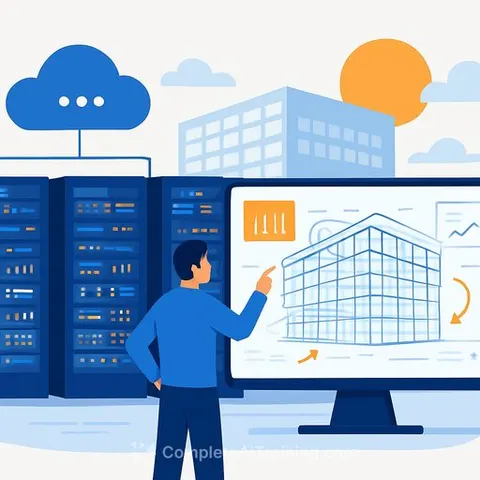
AI Data Centers Now Demand Gigawatt-Scale Planning. Digital Twins Are Essential.
Data center investments are projected to reach $7 trillion by 2030, with AI facilities now planned at gigawatt scale. That means power demand from data centers is rising four times faster than electricity demand from all other sectors combined.
The scale creates a planning problem. AI factories require hundreds of companies and specialist disciplines - technology vendors, utilities, regulators, contractors and operating teams - to coordinate on systems that are still evolving. Compute density increases continuously. Cooling strategies are changing. Grid conditions are tightening. Traditional project delivery models, built for slower cycles with stable requirements, don't work.
Communities and utilities have competing priorities: grid stability, environmental responsibility, and economic benefit. Owners need capital efficiency and speed to market. These demands often conflict when decisions are made sequentially rather than tested together.
Digital Twins Move Constraints Into View Earlier
Digital twins - virtual replicas of facilities with physics-based simulation - have shifted from optional to necessary. They let teams test trade-offs before decisions become irreversible.
The most effective digital twins combine three elements: a high-fidelity 3D replica, simulation-ready assets for testing performance scenarios, and industrial-grade automation for operations. Teams place these digital assets into a shared virtual environment built on physics engines that allow full testing before physical construction begins.
This approach compresses early-stage work that typically takes six months to a year into weeks. Teams can ask practical questions earlier: What happens if the site boundary shifts? How do designs perform during a heatwave or around a floodplain? What's the impact on power and cooling demand? What happens if a generator fails during peak demand?
The value comes from combining advanced virtual modeling with deep domain expertise in design, construction, commissioning, and operations. The digital twin becomes a decision-making tool from the start, not a visualization added later.
Facility Design and Community Impact Are Coupled
For AI facility owners, digital twins inform capital decisions and projected operating costs. They address two core challenges: controlling costs and anticipating operational requirements.
At the planning stage, digital twins make design trade-offs visible across power, cooling, redundancy, and cost. Once operational, the same environment provides performance insights for cooling and energy efficiency gains.
The key insight: data center performance and community impact are inseparable. Choices that shape uptime and cost also determine how a facility cooperates with the local grid and uses water systems. Digital twins bring those constraints into the same model early enough to change outcomes.
Developers can model energy demand and water use against local climate conditions. Utilities gain certainty for infrastructure planning. Communities gain confidence that growth accommodates local capacity. The result is a facility with lower resource and energy footprint that supports community needs.
Building at the Speed the Market Demands
The infrastructure buildout underway is the largest in history. The speed of change is difficult to overstate.
The question facing the industry: can we build intelligently, balancing speed with responsibility? Modeling trade-offs early and demonstrating new design options realistically is what turns speed into judgment. That's how to deploy capital and AI infrastructure well, and how to build at the scale the market requires.
For teams in real estate and construction, understanding how to apply digital twin technology to gigawatt-scale projects is becoming essential. AI for Real Estate & Construction and AI for Operations are reshaping how infrastructure projects are planned and executed.