
AI news ·
Doctors warn against relying on artificial intelligence for medical decisions
Indians use AI chatbots for 24-hour symptom checks instead of calling doctors. Experts warn these algorithms lack clinical context and risk false medical reassurance.
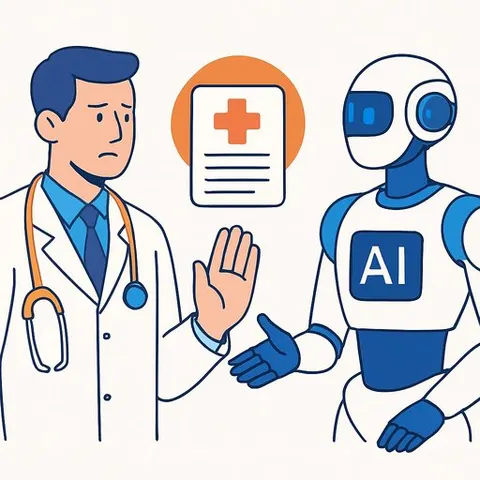
Across India, people are increasingly opening AI chatbots and symptom checkers instead of calling a doctor - a trend that is reshaping the first moments of a health scare. The convenience of an instant answer fills a gap in a system where specialist care can be hours away, but medical experts warn that relying on algorithms without professional oversight carries serious risks.
The appeal of immediate answers
In rural areas, reaching a doctor may take hours; in cities, appointments can be expensive and hard to get quickly. AI offers something healthcare often struggles to provide: an immediate response. Many tools can organize symptoms, ask follow-up questions, and flag whether a condition might need urgent attention. Dr Kunal Sehgal, managing director and chief pathologist at Neuberg Sehgal Path Lab, said, "Patients want information quickly, clearly and 24 hours a day. Given the unevenness of access to doctors, AI can help people identify indicators of serious illness much sooner than traditional means would allow and help them navigate the healthcare system more efficiently."
Why a chatbot cannot examine a patient
Medicine is built on context. A cough could signal a viral infection, asthma, heart failure, or acid reflux. A stomach ache might be indigestion - or a surgical emergency. Dr Abhinandan Sadalge, consultant urology at P D Hinduja Hospital and MRC, Khar, said, "Medicine is rarely as simple as matching symptoms to a list." He also said that a computer cannot judge how unwell someone looks, hear the exhaustion in their voice, or notice the tremor in their hands.
Doctors spend years learning to interpret subtle clinical signs that no questionnaire can capture. "Health and wellbeing cannot be reduced to a series of symptoms and data points," Dr Sehgal said. Family history, emotional state, medications, and living conditions all shape a diagnosis.
False reassurance and unnecessary alarm
The danger of unsupervised AI consultations is that the technology can be wrong, but people may trust the wrong answer too deeply. Dr Sadalge called false reassurance the greatest concern: "A patient who is told that a symptom seems harmless may delay urgent care." Conversely, an algorithm that flags a minor symptom as serious can trigger panic and unnecessary testing. Dr Sehgal said that if a patient incorrectly believes they have been reassured by AI, treatment could be delayed; if they are given a false sense of urgency, it adds strain to emergency rooms.
Where AI fits in Indian healthcare
India's healthcare system faces a shortage of specialists and a large patient load. AI is already making inroads in radiology and pathology, where pattern recognition can speed up screenings. Dr Sheena Alphones, consultant oncopathologist at NM Medical Lab, pointed out that modern digital pathology tools can spot microscopic abnormalities and help specialists in remote areas.
But the country's wide variation in access and disease patterns makes blanket algorithms risky. A symptom in a metropolitan hospital might point to one condition; the same symptom in a village clinic might require a different approach entirely. "AI is perfect at recognizing patterns, but it cannot assess the whole situation in the clinical environment by itself," Dr Alphones said.
Multiple organizations now offer AI for Healthcare Training courses that teach clinicians how to use these tools responsibly without over-relying on them.
Doctors with AI, not against it
The future is not a contest between physicians and algorithms. "A reasonable vision of the future is not man against AI. A reasonable vision of the future is man with AI," Dr Sadalge said. AI can sift through records, highlight patterns, and reduce paperwork, giving doctors more time for what technology cannot replicate. Dr Alphones said that the most productive future combines technological strength with human compassion. "The role of artificial intelligence complements the compassion and empathy of human doctors," she said.
Dr Sehgal said that AI can free providers to spend more time "listening, assessing, explaining and supporting patients in making difficult decisions about their course of treatment."
Why this matters for healthcare professionals
For clinicians and hospital administrators, the rise of AI-first consultations means that patient interactions increasingly begin with a machine's preliminary input. Professionals need to be prepared to correct misinformation, educate patients on the limits of symptom checkers, and integrate AI-generated summaries cautiously. Training in AI literacy will become as essential as clinical skills, ensuring that technology remains a support tool - never a substitute for the observation and judgment that only a human can provide.