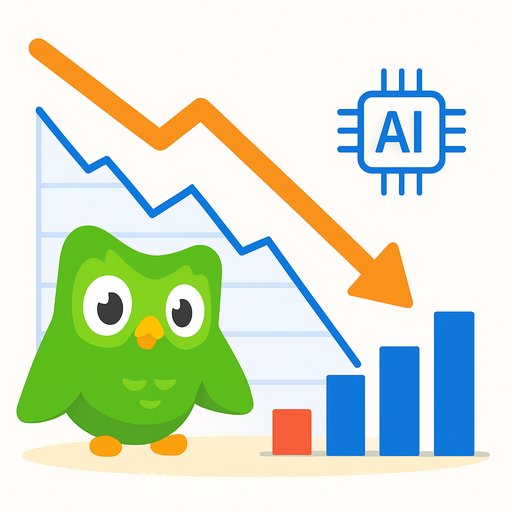
Duolingo's AI bet hasn't paid off. Its stock has lost 77% in a year.
Duolingo shares plunged again this week despite beating earnings expectations across the board and raising full-year profit guidance. The stock has now fallen nearly 80% over the past 12 months, a collapse that reflects a fundamental shift in how investors view the company's competitive position.
The language-learning app was once seen as an artificial intelligence winner. Investors believed generative AI and LLM technology would let Duolingo expand its language library, improve educational content, and drive user growth. That thesis has unraveled.
OpenAI, Anthropic, and Google have launched AI tools that let users build personalized language-learning applications with a few prompts. These alternatives now compete directly with Duolingo's core offering, threatening to undermine the company's growth trajectory.
The numbers show strain. Daily active users met expectations last quarter, but monthly active users came in at 138 million versus Wall Street estimates of 143 million. That gap signals slowing momentum.
CEO Luis von Ahn has defended an "AI-first" strategy and previously said the company aims to build an app that teaches "much better than anything that humanity has seen before." Yet even aggressive AI investment may not prevent commoditization of the product itself.
The company also dialed back what it called "unhinged" marketing tactics, which von Ahn blamed for recent growth slowdowns. That restraint, combined with the emergence of free AI alternatives, has left Duolingo caught between two pressures: moderating its growth engine while facing new competitive threats it can't easily control.
For executives in software and digital services, Duolingo's trajectory offers a cautionary lesson. AI for Executives & Strategy decisions require more than technological adoption-they demand clarity on defensibility and competitive moats once the technology becomes widely available.
Your membership also unlocks: