
AI news ·
Eagle Adler brings U.S. and German officers together for joint planning exercise at Fort Leavenworth
U.S. Army and German Bundeswehr officers spent a week at Fort Leavenworth planning division and corps-level combat operations during Eagle Adler. The exercise, nearing its 60th year, adds roughly 100 hours of joint planning to students' coursework.
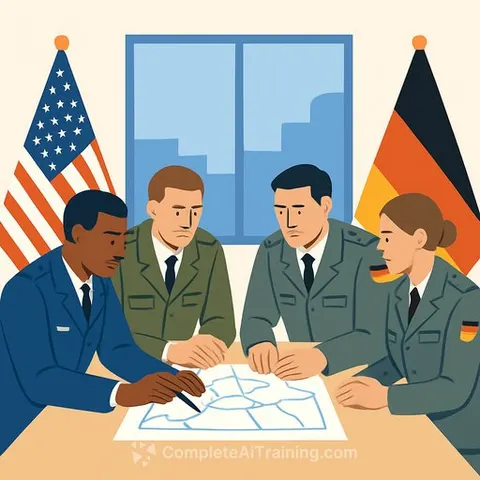
Army and German Forces Plan Large-Scale Operations Together in 60-Year-Old Exchange
U.S. Army and German Bundeswehr students gathered around acetate-covered maps at Fort Leavenworth this week to plan division and corps-level combat operations during Eagle Adler, one of the Army Command and General Staff College's longest running joint exercises.
The exercise brings together more than a dozen German students with American officers for intensive planning work. This year's iteration, which runs just over a week, incorporated artificial intelligence and command operating collaboration systems alongside traditional planning methods.
Building Interoperability Through Shared Problem-Solving
Eagle Adler adds approximately 100 hours of planning exercises to students' coursework. The two-part exercise requires officers to work through NATO APP-28 and the Military Decision-Making Process on an Indo-Pacific scenario.
Rob Smith, assistant professor and exercise lead in CGSC's Department of Army Tactics, said the core purpose is straightforward: "Exercises like this strengthen critical thinking by exposing students to how different partners approach problems and apply their experience to tactical problem sets."
Maj. Mark Marten, a U.S. Army logistician, described the value plainly. "We've got the time and space to really sit down and plan through some complex problems and issues that we would face when we work together downrange," he said. "This is probably the best time and only opportunity we have to calmly plan through very complex problems."
Trust Builds Fast, Learning Follows
Lt. Col. Michael Utsch, a German Army student, said professional trust emerged quickly during the week, allowing officers to focus on understanding each other's military approaches rather than getting acquainted.
Working through planning problems together revealed differences in how American and German officers handle risk and uncertainty. Marten noted those differences matter: "Having an opportunity to understand what they could be thinking, or how they would approach a certain problem provides us insight as well as clear, concise language to get through some of the interplay of confusion when it comes to translation."
Utsch emphasized the larger stakes. "In a security environment that is becoming increasingly complex and unpredictable, it is clear that we have to face future challenges together," he said. "The relationship we build here today will be essential for the missions we may face together tomorrow."
A 60-Year Commitment to Allied Training
Lt. Col. Marc-Andre Walther, assistant professor in CGSC's Department of Tactics, connected the exercise to broader military education goals. "Knowledge must become capability," he said, citing Carl von Clausewitz. "The exchange directly contributes to that."
The longevity of Eagle Adler reflects sustained commitment from both nations. Next academic year, the exercise will mark its 60th year.
For educators designing professional military education programs, the exercise demonstrates how structured, repeated exposure to joint planning-combined with peer learning from allied forces-builds the skills officers need before deploying together.