
AI news ·
Educational experts advocate using artificial intelligence to replace memorization with critical thinking
Experts say AI's rise in cheating is pushing schools to abandon memorization for active, hands-on learning. Jason Green of Yourway Learning calls the shift a "gift," arguing the real antidote is moving students off cognitive off-loading and into project-based, critical-thinking instruction.
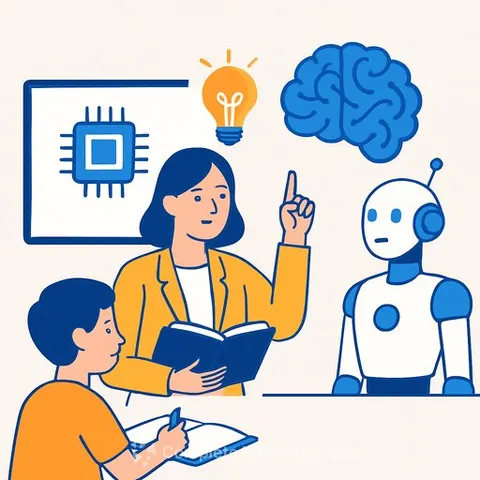
Educational experts say artificial intelligence, widely criticized for enabling student cheating and threatening entry-level jobs, could instead force a fundamental shift in how schools teach. They argue that the technology, if used as a tool for deeper learning rather than a shortcut, may push K-12 and college instruction away from memorization toward critical thinking, creativity, and hands-on projects.
The cheating crisis as a catalyst for change
Students from elementary school through college have used AI to write essays, complete programming assignments, and answer take-home tests - a practice experts call "cognitive off-loading." Teachers report that many students can no longer perform basic tasks like writing after skipping months of instruction. But Jason Green, who helps school districts improve education through AI with his company Yourway Learning, sees this moment as an opportunity.
"If our systems primarily measure remembering and understanding… AI doesn't just threaten that model, it renders it obsolete," Green said. "I think this is a gift. The real antidote is active learning. Let's get off the cognitively offloading train. Let's move to a system where active, hands-on learning is the norm."
AI as a career enhancer, not a job killer
Russell Sage associate professor Haidy Brown urges her college students to view AI as a tool they can direct, not a black box that does their thinking for them. She recalled spending a year as a graduate student analyzing 10 years of Federal Reserve transcripts for themes. Today, she would upload them to AI and get answers faster. "What could we have done in that year?" she said. "I could have learned more."
Brown predicts that in the future, students and young professionals will complete such tasks more quickly, giving them more time for the higher-value parts of their work. She acknowledged recent job cuts in fields like finance and computer science but argued that AI will eventually be a force for good in the job market. In healthcare, she said, providers hope AI will handle paperwork, freeing up more time to see patients. Mechanics are already using AI to diagnose cars with more accuracy and speed.
Teaching students to guide AI with critical thinking
SUNY Empire State professor Diane Shichtman focuses on teaching her students how to use AI responsibly. "I don't know what tools they're going to have three years from now, but I know what kind of questions they should ask," she said. Her first rule: "I ask students to think about how the data they're putting in will be used. You don't want to put personal data into a tool that's going to spread it all over."
She pushes students to define exactly what they want an AI tool to achieve and how it should get there. For example, SUNY Empire State has a library AI tool that searches only the library's databases. But she insists that students cannot use AI to learn how to think. "At the college level, we've always wanted them to do more than memorizing dates. We've wanted them to ask questions," she said. "The synthesis, the evaluation. And that's more important now."
Teachers are also using AI to develop lesson plans that account for every student - those with disabilities, those who are behind or ahead, and those who learn best through hands-on work. Green worked with a new teacher who used AI to build complex instructional practices that many veteran teachers cannot match. For educators seeking to develop these capabilities, an AI Learning Path for Teachers provides structured training.
Why this matters for educators
The conversation around AI in education is moving from panic to pragmatism. The technology is not going away, and the students who learn to wield it with critical oversight will be better prepared for workplaces where AI is a standard tool. Educators who shift their classrooms toward active, project-based learning and teach students to supervise AI outputs will build the judgment skills that both higher education and employers demand.
As AI tools become more embedded in lesson planning and student work, the need for thoughtful integration will only grow. Resources on AI for Education can help teachers stay ahead of these changes, but the core task remains: ensuring that every student can think clearly enough to direct a machine - and to catch its mistakes.