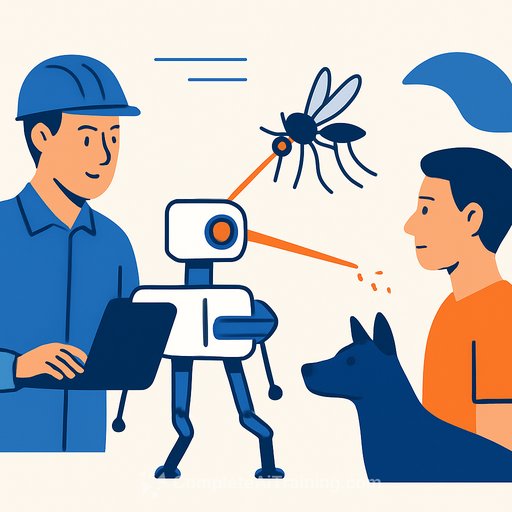
Autonomous Laser System Targets Mosquitoes While Protecting Humans and Animals
An engineer has built a rolling robotic system that autonomously detects and eliminates mosquitoes using a laser, with built-in safeguards to prevent harm to people and pets. The device combines a digital camera with zoom capability, a wide-angle surveillance camera, and AI-powered target recognition to identify and fire on mosquitoes only when the environment is clear of humans, animals, and flammable materials.
The system addresses a specific pest control challenge: Aedes albopictus, the tiger mosquito, bites primarily during daylight hours-morning and evening-when most conventional mosquito control methods are ineffective. Traditional approaches like nets and nighttime-only treatments miss this window entirely.
Why This Matters Now
Tiger mosquitoes are spreading northward into Europe, driven by climate change and their own rapid reproduction. Scientists warn that chikungunya, a virus historically confined to tropical regions, could establish local outbreaks in temperate areas as the mosquito population expands.
Existing commercial alternatives-including a Chinese-manufactured laser device-cannot be approved for consumer use because they pose eye injury risks to humans and animals. This DIY system solves that problem through environmental surveillance.
How the System Works
The device operates on a rolling chassis equipped with a digital SLR camera and AI modules for target recognition and laser firing. Once trained to identify mosquitoes, the system runs autonomously: it detects targets, confirms they are mosquitoes, checks the surrounding environment, and fires only when safe.
The second camera-the safety mechanism-continuously monitors the area. If it detects people, pets, or flammable materials in the mosquito's flight path, the system blocks the shot. This selective approach eliminates the safety liability that disqualified competing products.
Current Status and Limitations
The system remains a DIY project without commercial availability. The engineer built it as a proof of concept, not as a finished product ready for mass production or regulatory approval.
For researchers and professionals working in pest management, epidemiology, or disease vector control, the project demonstrates how AI agents and automation can address real-world problems in ways that existing solutions cannot. The integration of computer vision, autonomous decision-making, and safety constraints reflects approaches increasingly relevant to AI for science and research applications.
As tiger mosquito populations establish themselves in new regions, the demand for daytime pest control solutions will only increase.
Your membership also unlocks: