
AI news ·
Enterprises bear legal liability when AI systems give customers wrong or harmful answers
When AI gives a customer a wrong answer, the company that deployed it owns the liability - not the model vendor. In regulated industries, one misstep can trigger formal complaints, investigations, or consumer harm claims.
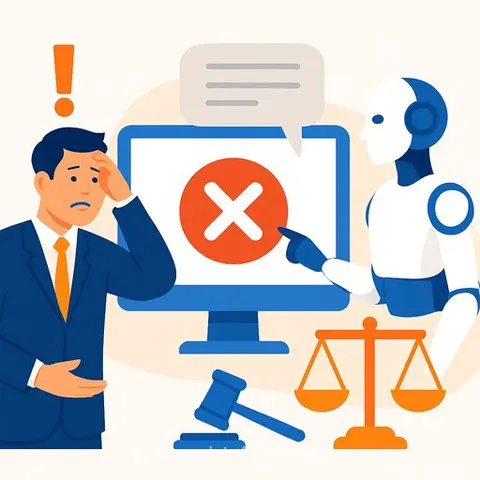
Who Is Liable When AI Answers Your Customers?
The moment a generative AI system produces a wrong answer to a customer, liability stops being theoretical. If that customer relies on the mistake and gets harmed, your organization cannot blame the model vendor. You deployed it. You benefit from it. You own what it says.
This matters most in regulated industries-financial services, healthcare, insurance, legal advice. A wrong answer about eligibility, coverage, safety, or compliance is not a quality issue. It becomes consumer harm, a complaint, or a regulatory inquiry. When auditors ask "Who approved this to speak?" vague answers do not hold up.
Why Vagueness Creates Liability Fast
Regulated customer conversations do not grade on a curve. One misstep can trigger formal investigation.
Vagueness also breaks internal accountability. Legal assumes product is governing. Product assumes compliance approved it. Compliance assumes operations is reviewing. Meanwhile the chatbot keeps talking to customers.
The Four Predictable Ways AI Fails Customers
Misinformation. Generative systems sound confident while being wrong. That combination is uniquely dangerous in customer service.
Bias. If the system treats certain customers differently, your organization wears that outcome. The harm is quieter than misinformation but just as costly.
Non-compliant claims. The model might promise something your policy does not support. It might paraphrase regulated language incorrectly. It might invent a next step. In regulated communications, invention is not helpfulness. It is exposure.
Unsafe guidance. The system might offer instructions that create physical, financial, or security harm. Even if you never intended it to advise, customers will ask. The bot will answer unless you design it not to.
Name Owners. Make Accountability Real.
If your accountability model is a group chat, you do not have a model. You have a liability fog.
A defensible approach names specific owners and makes their scope clear:
- One person owns the business outcome and risk acceptance.
- Another owns compliance interpretation and sign-off.
- Another owns system behavior: prompts, retrieval rules, and release management.
- Operations owns day-to-day reality: escalations, quality assurance, incident response, and coaching.
The point is not to create a committee. The point is to ensure hard questions have real answers. "Who is accountable?" should never lead to silence.
Sort Interactions by Risk Level
The fastest teams do not review everything. They review the right things.
Low-risk questions can stay automated with tight guardrails. Medium-risk topics need stricter phrasing and stronger monitoring. High-risk interactions should default to human handling or require approval before sending.
Escalation rules do the heavy lifting. They should be simple, testable, and easy to audit. Trigger escalation when:
- The customer mentions regulated topics: health, money, legal threats, safety.
- The customer asks for a promise, exception, refund, or contractual commitment.
- The system cannot cite an approved policy or knowledge source.
- The customer signals harm, confusion, or intent to escalate.
When escalation rules are clear, speed improves. Agents stop guessing. Customers stop looping. Leaders stop relying on hope.
Lock Down What the System Can Say
If your system can say anything, it eventually will. Content controls prevent that.
Restrict answers to approved sources. If the model cannot ground an answer in your knowledge base, policy library, or approved disclosures, it should not improvise.
Define prohibited claims. These are the promises, assertions, and regulated statements the system must never generate. Use templates for sensitive topics so the system applies approved phrasing instead of creative paraphrase.
Treat prompt changes like production changes. Log them. Review them. Roll them back when needed. Uncontrolled updates are not iteration. They are untracked risk.
Policy, Monitoring, and Approval Work Together
Policy sets the rules. Monitoring checks whether anyone is speeding. Approval workflows decide which systems can go live.
If you only write policy, you have a document. If you only monitor, you have alerts without control. If you only approve, you have gatekeeping without learning. Together, these three create a governance system you can defend in front of regulators and customers.
Monitoring matters most after launch. Models drift. Policies change. Product teams tweak prompts. New edge cases appear. When you can see what the system said, why it said it, and what happened next, you can fix issues fast and prove you fixed them.
If Your AI Is Already Live
You do not need a full reset to get safer quickly. You need focus and evidence.
- Inventory use cases and label them low, medium, or high risk.
- Turn on logging for prompts, outputs, sources, and escalations.
- Restrict answers to approved knowledge and policy content.
- Add escalation triggers for regulated and high-risk language.
- Assign named owners for outcomes, compliance sign-off, and operations.
This is where responsibility starts to look real. Not perfect, but provable.
Accountability Is How You Scale Safely
Customer-facing AI is not inherently reckless. Unmanaged customer-facing AI is.
Once automation touches regulated, high-risk interactions, liability cannot stay ambiguous. The answer is not to freeze AI for Customer Support. The answer is to operationalize accountability: human review where it matters, escalation rules that trigger consistently, content controls that prevent risky claims, and monitoring that produces audit-ready evidence.
Trust is the headline metric. You earn it by shipping with discipline.