
AI news ·
EU AI Act's August 2026 deadline brings new transparency, emotion recognition and literacy rules for CX teams
EU AI Act compliance deadlines hit customer support teams in August 2026, requiring AI disclosure, emotion-recognition rules, and mandatory staff training. Fines for violations reach 7% of global turnover-higher than GDPR penalties.
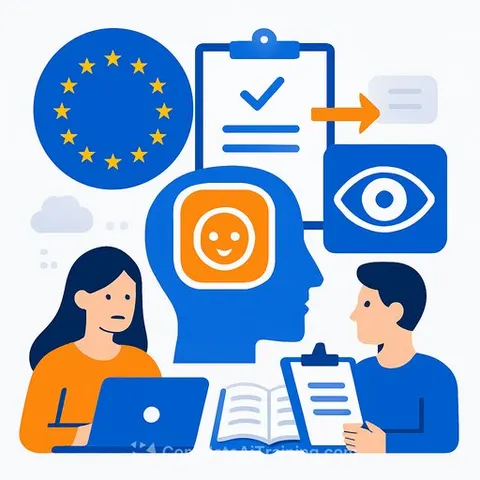
EU AI Act Compliance Deadline: What Customer Support Teams Need to Know
August 2, 2026 marks the primary deadline when most of the European Union's Artificial Intelligence Act takes full legal effect. Customer support teams will face three major operational changes: mandatory disclosure of AI use, new rules on emotion recognition systems, and required AI literacy training for staff.
Penalties for non-compliance are steep. The most serious violations carry fines of seven percent of global turnover or €35 million, whichever is higher-significantly higher than GDPR violations, which cap at €20 million or four percent of turnover.
Transparency: Telling Customers When AI Is Handling Their Requests
Organizations must inform customers they are interacting with AI unless it is obvious to a "reasonably well-informed, observant and circumspect person" based on context. This requirement applies from August 2026.
The disclosure must happen both in the moment during the interaction and in company policy. Generic statements about AI use do not meet the requirement. If AI influences a decision affecting the customer-such as a loan assessment or product recommendation-the disclosure must be explicit and detailed, explaining what the AI did and how it reached its conclusion.
Customers must also have the option to bypass AI and speak with a human agent. While this has long been considered best practice, making it a legal requirement creates new challenges for service planning and workforce management.
Emotion Recognition: Tracking Customer Sentiment Now Requires Compliance Work
Systems that track customer emotion or sentiment fall into the "high-risk" category under the Act. Organizations must disclose their use starting August 2026, with full compliance required by December 2027.
High-risk systems require data governance aligned with GDPR, robust cyber security, transparent customer interactions, and continuous human oversight. Before deploying these systems, organizations must register them in the EU database and complete a conformity assessment-a technical documentation process that may require third-party verification.
AI Literacy: Staff Training Becomes Mandatory Infrastructure
All staff using or managing AI systems must receive training appropriate to their role. The Act requires organizations to ensure "a sufficient level of AI literacy" covering technical knowledge, experience, education, and the specific context where AI will be used.
This goes beyond a one-time onboarding exercise. AI literacy must become embedded infrastructure-how teams work day-to-day, not a box checked during hiring.
Hard skills should include:
- AI governance, risk, and bias management
- Data oversight and business process management
- Documentation and audit trail management
- Understanding the Act's obligations by role (provider vs. deployer) and how they intersect with GDPR and sector-specific regulations
Soft skills should include:
- Critical thinking and ethical reasoning
- Cross-functional communication and customer empathy
- Escalation judgment and service design
- People and change leadership
Skills must be tested through scenario-based exercises, not just recall. A customer service agent needs different AI literacy than a product manager or compliance officer. Testing should reflect actual job responsibilities and occur at least annually, with more frequent assessment for high-risk deployments.
Learn more about AI for Customer Support to build foundational knowledge for your team.
The Workforce Management Problem: Predicting Demand When Customers Opt Out
The transparency requirement creates a practical headache: if customers can easily choose to speak with a human instead of AI, organizations can no longer reliably predict how many contacts AI will resolve. This undermines the cost-per-contact assumptions that justify AI investment.
Service planning depends on forecasting demand. When opt-out rates become unpredictable, agent scheduling, SLAs, and cost models break down.
To manage this, organizations should model two distinct service streams: one for AI-handled interactions and one for human-only requests. Each stream needs separate SLAs and routing rules. Headcount planning must account for a baseline of human-only volume that cannot be deflected to AI.
Peak demand modeling is also necessary. Opt-out rates may spike after AI incidents or negative media coverage, creating sudden surges in human contact volume. Agents handling opt-out customers may also need additional training-these customers are often already frustrated or distrustful of AI and may ask more advanced questions.
A steady rise in opt-out rates signals a broader trust issue before it shows up in customer satisfaction scores or churn. CX leaders should track opt-out rates as a governance metric, not just a capacity planning variable.
For guidance on managing these operational shifts, review the AI Learning Path for Call Center Supervisors, which covers workforce optimization and chatbot management in the context of changing customer preferences.
Moving Forward: Building Trust Over Compliance
As AI quality improves, many customers will still choose AI interactions if given genuine choice. Organizations that design transparency and choice into the experience-rather than treating them as regulatory burdens-can turn compliance into customer trust.