
AI news ·
Federal judge signals Workday faces California bias claims in AI hiring lawsuit
A federal judge signaled Workday will face the first class action over AI hiring bias, affecting tools used by 80% of U.S. employers. This could expand vendor liability.
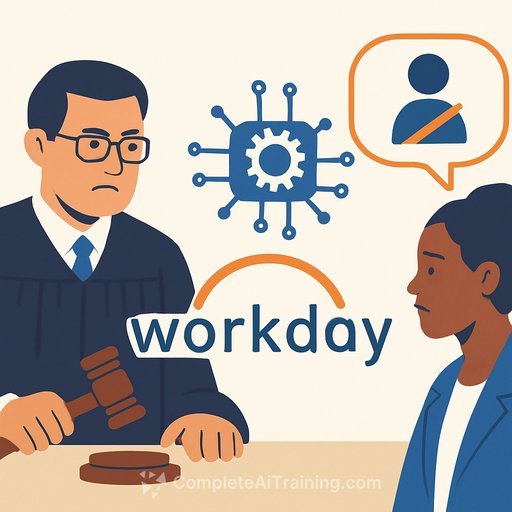
A federal judge signaled on Monday that Workday will likely have to face claims it violated California anti-discrimination law thousands of times by using AI to screen out job applicants for discriminatory reasons. The case is the first class action to broadly target algorithmic hiring software, a tool now used by more than 80% of U.S. employers, and could reshape legal exposure for both software vendors and the HR departments that rely on them.
The lawsuit began in 2023 when Derek Mobley alleged he was passed over for more than 100 jobs at companies using Workday's screening tools because he is Black, over 40, and has anxiety and depression. The case has since expanded to include three additional named plaintiffs and broader claims under federal law and California's Fair Employment and Housing Act (FEHA).
During a hearing in San Francisco, U.S. District Judge Rita Lin pushed back hard against Workday's argument that it cannot be liable under FEHA when it screens applicants based outside California for jobs in other states or countries. "So the alternative then is for Workday to be subject to the laws of all 50 states and countries around the world, depending on which employer is deploying its software. Is that really what you're saying? It seems odd to me," Lin said to Kayla Grundy, an attorney for Workday.
Grundy argued that Workday's liability as an agent of its customers depends on whether each individual employer broke the law, and that there were insufficient contacts with California when screenings involve out-of-state applicants for out-of-state employers. Lin countered by citing a 30-year-old California appeals court decision that said parties can be directly liable for their own engagement in activities regulated by the FEHA. "The court's focus appeared to be on where the tortious conduct occurred. What am I missing?" the judge said.
Roderick Cooks, representing the plaintiffs, told the court that the goal was to hold Workday accountable for its own conduct inside California. "We're just trying to make Workday stand up for what it did within California as far as algorithmic decisionmaking (and) tool developing," Cooks said. Lin did not indicate when she would rule, but her 2024 decision in the same case already broke ground by finding Workday could be considered an employer under federal workplace discrimination laws because it performs screening functions employers would normally handle themselves.
A test case for AI hiring tools
The Mobley lawsuit is the first to directly challenge the algorithmic decisionmaking behind AI screening software that has become nearly universal among large employers. Numerous surveys show that virtually all Fortune 500 companies and more than 80% of U.S. employers use AI in hiring. Government agencies and worker advocates have long warned that these tools can bake in bias when trained on data that reflects existing inequalities, but litigation has been rare - partly because many applicants don't know AI is being used and partly because suing over opaque technology is difficult.
The widespread use of AI in hiring, covered in resources like AI for Human Resources, makes this case particularly relevant for HR professionals. A ruling that allows FEHA claims to proceed could open the door to similar challenges in other states, forcing companies to scrutinize the screening algorithms they purchase or build.
What the judge's signal means for employers
If Lin ultimately rules that Workday can be sued under California law for screenings that occur out of state, it would expand the liability of AI vendors as agents of their employer-customers. HR departments that rely on third-party screening software may need to revisit vendor contracts to clarify who bears legal risk for discriminatory outcomes. The decision could also pressure companies to demand that AI tools be tested for bias across all jurisdictions where they are deployed, not just in California.
Workday's argument that it should only face the laws of the state where each employer operates was met with clear skepticism. Lin's line of questioning suggests she may find that a company developing and running algorithmic screening tools from California can be held directly liable for its own conduct under FEHA, regardless of where the job applicant or employer is located.
Why this matters for HR professionals
The case underscores the legal risks of deploying AI screening tools without rigorous bias testing and transparent processes. HR leaders should take several concrete steps now:
- Audit AI vendors for compliance with state anti-discrimination laws, especially if the vendor operates or develops tools in a state with broad protections like California.
- Require clear documentation of how algorithms make screening decisions and how they are tested for disparate impact.
- Train hiring managers and recruiters to recognize signs of AI-driven bias and to question screening results that appear to disproportionately exclude protected groups.
To build these competencies, HR teams can turn to the AI Learning Path for HR Managers, which covers recruitment automation and talent management compliance. As this lawsuit moves forward, it will likely set important boundaries for how AI hiring tools are built, sold, and used - and HR departments that prepare now will be better positioned to adapt.