
AI news ·
Food manufacturers expand AI use across product development as agentic tools take hold
Major food companies are using AI to cut product failure rates by analyzing consumer trends and testing concepts before production begins. Systems like Ai Palette's Arya can generate and screen ideas in hours, compressing what once took months.
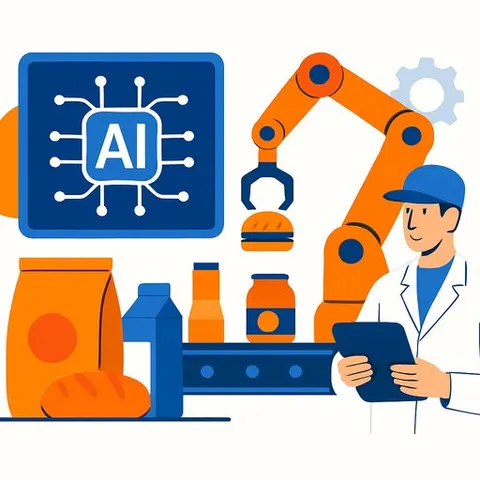
Food Companies Deploy AI Across Product Development to Cut Failure Rates
Major food manufacturers are using artificial intelligence throughout their product development processes to speed concepts to market and reduce costly commercial failures. The shift reflects a broader move from AI as a back-office tool to AI as a core part of how products get built.
Manufacturers are embedding AI earlier in development, using the technology to analyze consumer trends, test concepts and refine product ideas before they reach production. AI for Product Development now spans the full lifecycle, from identifying market opportunities to generating launch-ready briefs.
Patrick Young, managing director at PRS In Vivo, a consultancy working with companies including Mondelez, PepsiCo and Mars, said manufacturers are "using AI to get closer to consumer needs earlier in the process, analysing trends, testing concepts and refining propositions before they ever reach the shelf."
Spotting Weak Signals and Refining Formulas
Swiss ingredients supplier Givaudan built an in-house system called Customer Foresight that combines AI with big data to identify "weak signals"-early, fragmented indicators of future trends. Human staff, called "futurescapers," then analyze these signals and work with AI to sort data into patterns that suggest product ideas.
The result is fewer obvious misses and more concepts grounded in real consumer demand. Young said AI helps identify emerging behaviors like demand for high-protein products or gut health benefits and translates those into relevant concepts.
Ingredion, a US ingredients company, uses AI Data Analysis to identify taste and flavor combinations that appeal to consumers. The company has developed stevia-based sweeteners that reduce sugar content by up to 50% while maintaining taste, using AI to model and test formulations at scale.
From Research Tool to Autonomous Workflow
The biggest shift is toward "agentic AI"-systems that work autonomously across multiple steps without constant human prompting. Ai Palette, a platform used by Nestlé, Coca-Cola and Diageo, launched an agentic AI assistant called Arya that can identify market gaps, generate concepts, screen them against consumer data and produce launch-ready briefs without human intervention at each step.
Himanshu Upreti, co-founder of Ai Palette, said most food companies have moved past experimenting with generative AI. Some deploy AI agents for specific tasks-R&D agents that track internal metrics, formulation assistants that optimize recipes, or screening tools that validate concepts. But these are point solutions that hand off to humans between steps.
"True agentic AI, where the system autonomously executes multi-step workflows without constant human prompting, is just beginning to take hold," Upreti said. He added that Arya collapses what used to be a months-long process into hours, with richer data inputs and lower failure risk.
Why Food Companies Have an Advantage
Food manufacturers have deployed AI effectively because they already maintained large structured datasets. Will Telford, chief technology officer at Point74, a UK software company, said the real shift is not companies adopting standalone AI tools but layering AI over existing product data in their systems.
"Food companies have spent years curating incredibly rich datasets including recipes, cost structures, nutritional profiles and supplier specifications," Telford said.
AI also helps manufacturers navigate competing pressures: tighter cost targets, regulatory compliance, clean-label demands and shorter launch windows. During reformulation, AI compresses iteration cycles by modeling ingredient changes instead of requiring manual testing of each scenario.
Sustainability and Production
AI is also connecting decisions historically made separately. Sam Stark, CEO of Green Project Technologies, an AI-enabled carbon management platform, said the technology helps staff work from the same data simultaneously across procurement, quality and emissions reduction.
"When you can model the carbon implications of a formulation change or a supplier switch before you commit to it, sustainability stops being a constraint on product decisions and starts being an input to them," Stark said.
In production, AI-enabled machine vision and robotics improve inspection and handling during early-stage manufacturing. Vision-guided robots can identify and handle irregularly shaped products during cutting, helping manufacturers refine processes before scale-up.
Human Judgment Remains Essential
Experts agree AI is not replacing human involvement in food development. Patrick Young said AI acts as a filter or co-pilot that surfaces patterns and optimizes ideas, but human judgment creates something distinctive and emotionally engaging.
Dr. Kevin Deegan, vice president for innovation at Finnish dairy company Valio, said AI helps staff be more creative by handling routine work. "The biggest challenge we have in creativity as humans is our own minds," he said. "A lot of people believe 'I'm not creative. I'm a doer.'"
Valio uses AI to standardize data infrastructure and find patterns humans cannot see. But Deegan emphasized the technology frees staff to test, prototype and take chances-reducing the risk and uncertainty that inhibits creative thinking.
He added that the real issue is not whether AI will replace jobs but whether companies use it to give staff time to think beyond immediate pressures and explore new ideas for the market.