
AI news ·
Food System Innovations launches open-source AI lab to improve alternative protein taste
Funded by a $2M Bezos Earth Fund grant, an AI lab uses open-source tools to speed alt-protein taste testing. A dairy-free yogurt improved 29% in sensory score in just five days.
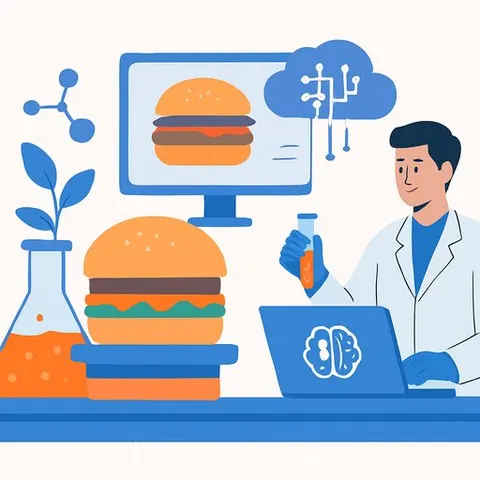
US non-profit Food System Innovations (FSI) has launched a Food Intelligence Lab to build open-source AI infrastructure that speeds development of better-tasting alternative proteins. The initiative, backed by a $2 million grant from the Bezos Earth Fund, tackles a persistent bottleneck: most plant-based products fail to match the sensory appeal of animal-based foods.
FSI's sensory analysis arm, Nectar, runs large-scale taste tests that reveal only about a third of American consumers like the average vegan alternative. More than 60% find conventional meat and dairy appealing. Food producers see the gap: 90% of major companies keep launching plant-based options, yet 77% admit that taste, cost, and nutrition concerns hold back consumer uptake.
How the lab treats formulation as an optimisation problem
Anna Thomas, a computer scientist at Stanford University and the lab's director of machine learning, said the team combines multiple data streams-sensory panel scores, instrumental measurements such as texture and pH, molecular composition, and past experiment logs-to build algorithms that guide product design.
"We treat food formulation as an optimisation problem: how do you maximise consumer satisfaction-taste, texture, overall liking-while meeting constraints like cost, nutrition, and manufacturability," Thomas said. The system recommends the "next best experiment," helping development teams bypass slow trial-and-error cycles.
One early result: a dairy-free Greek yogurt improved its sensory performance by 29% across just 10 formulation iterations in five days. On three of four key attributes-consistency, creaminess, and tanginess-it matched the animal-based benchmark. The gain came from an Expert-Guided Bayesian Optimisation (EGBO) algorithm co-developed with Proxy Foods AI, where a human expert or large-language model selects a small set of variables and the algorithm efficiently searches the formulation space.
Open-source benchmarks and shared infrastructure
The lab is also releasing public benchmarks like TasteBench, which evaluates how well AI models predict sensory similarity to a target animal product. Existing foundation models already perform competitively with the median human panellist, according to FSI. By putting datasets, models, and benchmarks into the open, the lab aims to reduce duplicated effort and let startups, researchers, and established firms build on a common foundation.
"Open-sourcing models, datasets, and benchmarks is a deliberate choice," Thomas said. "It allows startups, researchers, and established companies to build on a common foundation, improving comparability, reducing duplicated effort, and accelerating collective learning."
Reckoning with AI's own environmental footprint
Critics point out that AI itself consumes energy and water. A recent UN report raised concerns that the tech's climate impact often ignores inference-the day-to-day use of models for answering queries. Data centres stress public infrastructure from Uruguay to Mexico. Thomas acknowledged the tension but argued for evaluating AI's net effect.
"If AI can materially accelerate the shift toward better-performing, more affordable sustainable proteins, the downstream emissions reductions can be substantial," she said. The lab focuses on lightweight, domain-specific techniques rather than enormous general-purpose models. Bayesian optimisation, for instance, is far less energy-hungry than frontier AI systems, and it directly reduces the number of physical experiments-each carrying its own material and emissions footprint. Open datasets also prevent duplicate model training across the industry.
Why this matters for product development
For product developers, the Food Intelligence Lab demonstrates a practical path to compressing formulation timelines. Instead of running dozens of benchtop trials, teams can feed existing data into an algorithm that points toward the highest-impact variables and suggests the very next experiment. The approach turns sensory improvement into a quantifiable optimisation loop, with benchmarks that let you measure your model's performance against a public standard.
The open-source model means development groups can adopt these tools without building custom data infrastructure from scratch. As the lab expands its datasets and improves prediction accuracy on tasks like TasteBench, even small R&D teams can integrate AI for product development tasks that once required years of internal iteration. The yogurt validation shows what's possible in under a week-a signal that the gap between animal-based sensory targets and plant-based products is narrowing faster than many assume.